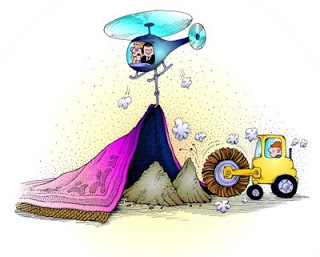
How should we judge a government?

In Malaysia, if you don't watch television or read newspapers, you are uninformed; but if you do, you are misinformed!

"If you're not careful, the newspapers will have you hating the people who are being oppressed, and loving the people who are doing the oppressing." - Malcolm X

Never argue with stupid people, they will drag you down to their level and then beat you with experience - Mark Twain

Why we should be against censorship in a court of law: Publicity is the very soul of justice … it keeps the judge himself, while trying, under trial. - Jeremy Bentham

"Our government is like a baby's alimentary canal, with a happy appetite at one end and no
responsibility at the other. " - Ronald Reagan

Government fed by the people

Government fed by the people

Career options

Career options
I suggest government... because nobody has ever been caught.

Corruption so prevalent it affects English language?

Corruption so prevalent it affects English language?
Corruption is so prevalent it affects English language?

When there's too much dirt...

When there's too much dirt...
We need better tools... to cover up mega corruptions.

Prevent bullying now!

Prevent bullying now!
If you're not going to speak up, how is the world supposed to know you exist? “Orang boleh pandai setinggi langit, tapi selama ia tidak menulis, ia akan hilang di dalam masyarakat dan dari sejarah.” - Ananta Prameodya Toer (Your intellect may soar to the sky but if you do not write, you will be lost from society and to history.)

Sunday, March 19, 2017

DR MUHAMMAD AZRIF: Cancer patients deserve better

Excerpt:

"WE would like to thank Gan Tee Jin for the letter “Keeping an open mind on unproven treatments” (The Star, March 10). We appreciate the effort to describe his family’s experience with HITV (Hasumi Immuno-Therapeutic Vaccine) and are glad that his mother has had a successful outcome after her treatment.

His mother is a living testimony that cancer is not always a death sentence, which sadly is an all too common perception among Malaysians.
We welcome feedback to our previous letter, “Clarifying immunotherapy” (The Star, March 3), and are keen to explain our position regarding oncology and evidence-based medicine.
The Malaysian Oncological Society (MOS) regards educating the public on cancer as one of our primary objectives and we strongly believe that the practice of oncology should be based on the best scientific evidence.
Gan’s letter raises several interesting points that continue to be debated in medicine, and science in general. Firstly, what kind of evidence is required to “prove” that something works? Is one successful case sufficient proof? Can we rely on our own, often flawed, observations to form judgements?"
Link

Thursday, March 16, 2017

Goop:Adam Cunliffe: 5 Cancer-Fighting Foods—Plus What to Avoid

Over half the population will be diagnosed with cancer at some point in their lifetime, the newest studies tell us. While many factors contribute to the data, it’s undeniable that lifestyle—including food—plays a major role in both reducing risk of contracting the disease and improving your chances of surviving it. As London nutritionist Adam Cunliffe points out, there’s not much to lose from adopting a diet designed to combat cancer; at worst, it contributes to weight loss and improved energy, and at best, it keeps a terrifying diagnosis at bay. Below, he breaks down what we know today about cancer and diet, and details common-sense practices you can start using now to reduce your risk.

Q
What does the major research tell us about diet and cancer?
A
One in two people will now get a cancer diagnosis in their lifetime, the newest public-health information tells us. Not long ago, the data was one in three—a shocking difference. Such a drastic change points to the fact that lifestyle is at least contributing to the increased risk.
It is estimated that a third or more of cancers are related to our diet. This can be related to foods that we aren’t eating enough of, such as fresh fruits and vegetables, or things we might eat too much of, such as salt, sugar, and refined carbs. Fortunately, with the right information, diet is one risk variable that’s entirely within our control.
Q
Can we quantify the risk reduction associated with a healthy diet?
A
It’s difficult to put a number to the diet factor in cancer, because so many other lifestyle and genetic factors are mixed up with risk. Plus, there’s always the random mutation effect—you could do everything right and still get unlucky.
That said, based on the best estimates, we think improved diet could reduce cancer risk by roughly a third. If we add to this, stopping smoking, avoiding excess stress, keeping physically active and avoiding high pollution levels, we can actually reduce risk dramatically. We are also confident that eating better has no downside—it’s something all of us can do right now to be healthier and feel better. If it could also help prevent a dreaded diagnosis, all the better.
Q
What are the distinctions between preventative and curative foods?
A
Eating to support a strong immune system can be preventive in the sense that cancer may not occur in the first place, but it can also be ‘curative’ in sense that cancer may arise but be eliminated before it ever has a chance to take a hold. We know that cancer cells frequently form in healthy people, but our immune cells promptly destroy them. It’s the reason that more men die with prostate cancer than of prostate cancer.
Even if cancer does get a grip in our bodies, we can inhibit its rate of growth and spread by eating an anti-cancer diet. While very few ‘cures’ (remissions) have been recorded following diet-only interventions, a notable case is documented in an individual who had complete remission from advanced cancer after self-medicating with high doses of green tea and pineapple. It could be argued that this was one of the rare ‘spontaneous’ remissions, but both green tea and pineapple are known to inhibit cancer cell growth (the anti-cancer potential of the epigallocatechin gallate in green tea and bromelain in pineapple are current cancer therapy research areas).
In conventional medicine, it’s heresy to say that a diet can cure cancer, because although there may be a few cases, oncologists are rightly worried that people would forego conventional treatment in favor of a diet-based program that may not be as effective. I don’t advocate for food-only cures, and recommend that everyone who has been diagnosed move forward with the advice of their oncologist, but I do believe that as a supplement to conventional treatment, diet is vital. For many people, diet is the first defense for keeping energy up, because body wasting is one of the worst side effects of many conventional cancer treatments. Most treatments involve breaking down parts of your immunity, so I’m particularly concerned with keeping up micro-density to support the immune system.


Link

Wednesday, March 15, 2017

Gan Tee Jin: Keeping an open mind on ‘unproven’ treatments

"I AM writing in response to the joint letter by the Malaysian Oncological Society and the President of the Singapore Society of Oncology (The Star, March 3).

Your letter is generally well written, offering sensible cautionary advice to cancer patients about “unproven” treatments.
While I cannot offer the breadth of data you demand (“clinical trials involving thousands of patients”) I will share one data point in an in-depth manner, in the hope that you see prima facie evidence that maybe Human Initiated Therapeutic Vaccine (HITV) works after all.
And since I am “replying” to oncologists, I will convey facts accurately from medical reports and supplemented by personal notes. I hope that laymen readers will bear with me.
My mother’s recent journey with cancer started with a transurethral resection of a bladder tumour (TURBT) to remove a low-grade bladder tumour in June 2012. Soon after, she noticed blood in her urine and this led to surgery to remove her left kidney and some surrounding tissues three weeks after the TURBT.
“Invasive high-grade transitional cell carcinoma of left renal pelvis....Resected margins are free from tumour,” the histopathology report concluded. While the surgeon was confident he had excised all the at-risk tissues, my mother was offered chemotherapy as a precaution.
After completing the cycles of carboplatin and gemcitabine chemotherapy, the CT scan radiologist reported on Jan 10, 2013 a “lymph node consistent with metastatic node. This is a new finding.”
A presumably stronger regime of chemotherapy involving taxol was given and once again the CT scan three months later showed the lymph node had grown.
A third concoction of chemo was administered (taxol and ifosfamide for four months).
Half way through, the oncologist prepared us for the worst, saying that if this chemo failed, then she could only offer hope to slow disease progression with future treatments.
Cure would be out of the question and future chemo would involve experimental drugs which the patient could import personally with the right paperwork.
I decided to check out the treatment at a clinic in Bangsar. I had no idea they offered immunotherapy, having heard only vague accounts through a friend that they had an alternate cancer treatment.
I went there (without my mother because I didn’t want to overload her with too much information), with an open mind and very inquisitive. I learnt that they offered P53 gene therapy and HITV.
I asked for scientific literature and explanation. While literature was skimpy the scientific explanation resonated with me and I also liked the idea that they did not entail serious side effects because they did not involve drugs.
Subsequently, a clinical response paper involving 167 patients was published in October 2013.
This paper showed very good success. It, however, did not influence our decision because it was published after my mother underwent HITV.
Getting back to the treatment time line, I decided (and my mother agreed) to try P53 mid-way through her third concoction of chemo. This was disclosed to the chemo oncologist.
The Bangsar clinic was quite upfront about the probability of success, or the lack of it. The post-chemo imaging report CT scan (PET scan this time) revealed that the “hypermetabolic left para-aortic nodal mass has increased in size. Neither chemo nor P53 worked.
We then abandoned further chemo, although the paperwork for the experimental drug was in order. In short, HITV commenced about a year after chemo was started.
The first PET CT, about three months after HITV treatment, reported: “The left para-aortic hypermetabolic nodes are gone, but there are other mildly hypermetabolic lesions situated more cranially and laterally” showed complete remission. As you rightly alluded in your letter, this is no proof that immunotherapy worked, given that high dose radiotherapy was administered.PET CT were done at three-month intervals, subsequently relaxed to six-month intervals. I’m happy to say that all these scans did not detect any cancer tumours. The latest scan is 38 months after HITV treatment.
Now, please recall how aggressive this cancer was – a new tumour in the para-aortic lymph node swelled it to 2.5 x 2cm in a span of about five months.
Take note also that HITV involves intratumoral injection of immature dendritic cells, a process that risks seeding tissues adjacent to the injection pathway with cancer cells.
By logical deduction, the radiotherapy part of HITV cannot have provided the systemic protection required to keep the patient free of any new tumours for 38 months, especially in the context of the aggressiveness of this cancer (my opinion).
Whereas the activated immune system could and probably did. To be clear, she received no cancer treatment other than HITV during this period.
Lastly, while clinical trial is a gold standard to aim for, you probably also know that it is very costly and a long journey. Meanwhile, the clock ticks for many cancer sufferers.
Just as my mother was allowed to import an experimental chemo drug, so too should patients have the option of HITV. I have certainly received more information on HITV than on the experimental chemo drug we were offered.
I believe doctors are taught the principle primum non nocere (Latin for first, do no harm). On this score, HITV does well with minimal side effects. One cannot say the same for the experimental chemo drug we were offered or FDA-approved immunotherapy drugs such as keytruda.
HITV was honed to its present state over decades by Dr Kenichiro Hasumi in Japan. Evidently America has cottoned on to this idea; former President Barack Obama launched the Moonshot 2020 programme last year to find “vaccine-based immunotherapies” against cancer! Wow, Obama was so specific when there are so many different approaches in immunotherapy.
Some background on me. I come from a family with strong history of cancer. My brother succumbed to colon cancer at only 32.
I would like to think that his premature death has a purpose for it spurred the rest of the family to do regular colonoscopy.
Several years later, we all went for genetic testing which revealed I have the HNPCC gene mutation.
With that, I undergo colonoscopy annually (for the past 20 years), and latterly annual ultrasound and biennial MRI as well.
These efforts paid off when I discovered a colon tumour (1997 at age of 38) and bladder tumour (2016) in very early stages and dealt with them successfully.
GAN TEE JIN
Kuala Lumpur

Source: http://www.thestar.com.my/opinion/letters/2017/03/10/keeping-an-open-mind-on-unproven-treatments/#8PXxDhgQIKglXvaA.99
Link

Monday, March 06, 2017

MALAYSIAN ONCOLOGICAL SOCIETY In conjunction with Dr Ravindran Kanesvaran :Clarifying immunotherapy

Excerpt:

"WE read with great interest the article “A case for immunotherapy” (Sunday Star, Feb 12). Firstly, we would like to congratulate Chin (nasopharyngeal cancer) and Wong (prostate cancer) on improvements in their condition and for their successful struggle against cancer. Many like these two men are increasingly facing up to the reality of a cancer diagnosis as its prevalence rises in the Asia-Pacific region. However, upon reading the article we also noted several disturbing points regarding their treatment which we would like to highlight here.
Firstly, immunotherapy is indeed emerging as a new and exciting breakthrough in our treatment armamentarium against cancer. Immunotherapy aims to harness or enhance the ability of our own immune system to recognise and mount an immune response against cancer cells. Indeed, over the past few years, several immune therapies such as PD-1 and PDL-1 checkpoint inhibitors have now received licensing approval from major health authorities such as the US Federal Drug Agency (FDA) and European Medicines Agency (EMA). Much time, cost and effort have gone into performing clinical trials involving thousands of patients in order to prove that these treatments are superior to current available treatments and can be safely given with acceptable side effects. Not least as these treatments are usually very costly, we need to be sure that they work before they are offered to the public.
In contrast, the HITV (Hasumi Immunotherapeutic Vaccine) treatment in combination with radiotherapy is not an FDA or EMA approved therapy. There are no large phase 2 or phase 3 clinical trials (such trials are a necessary requirement before new therapies can be approved by the regulatory authorities) that have been performed to prove that it works any better than conventional chemotherapy, radiotherapy or targeted therapy alone. Indeed, the clinical trials to explore whether cellular immunotherapy treatment such as HITV are effective are currently only in an initial stage of development and it is premature to suggest that these treatments should be offered widely to the public."

Read more at http://www.thestar.com.my/opinion/letters/2017/03/03/clarifying-immunotherapy/#YZpc1jGgr7ttkogX.99
Link

Which super sports car is the fastest of them all?

We have always wonder about the relative speed of  certain sports cars. Some look macho and fast, yet we can never tell among them. Well, wonder no more...

Those 11 drivers cars taking part: BMW 1-Series M, Porsche 911 GT3 RS, Ford Mustang Boss 302 Laguna Seca, Chevy Corvette Z06, Ferrari 458 Italia, Nissan GT-R, Audi R GT, Mercedes-Benz SLS AMG, Lexus LFA, Porsche Cayman R, and Lotus Evora S.

https://www.facebook.com/1017943909/videos/10211254599373608/

While we are at it, the big and clumsy looking Nissan Patrol made mincemeat out of a Porsche!


http://khaleejtimes.com/nation/dubai/inside-dubais-nissan-patrol-that-beat-a-million-dollar-porsche
Link