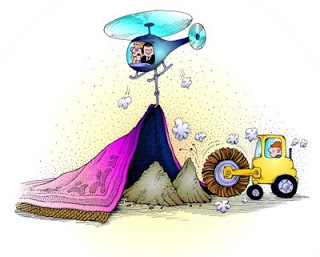
How should we judge a government?

In Malaysia, if you don't watch television or read newspapers, you are uninformed; but if you do, you are misinformed!

"If you're not careful, the newspapers will have you hating the people who are being oppressed, and loving the people who are doing the oppressing." - Malcolm X

Never argue with stupid people, they will drag you down to their level and then beat you with experience - Mark Twain

Why we should be against censorship in a court of law: Publicity is the very soul of justice … it keeps the judge himself, while trying, under trial. - Jeremy Bentham

"Our government is like a baby's alimentary canal, with a happy appetite at one end and no
responsibility at the other. " - Ronald Reagan

Government fed by the people

Government fed by the people

Career options

Career options
I suggest government... because nobody has ever been caught.

Corruption so prevalent it affects English language?

Corruption so prevalent it affects English language?
Corruption is so prevalent it affects English language?

When there's too much dirt...

When there's too much dirt...
We need better tools... to cover up mega corruptions.

Prevent bullying now!

Prevent bullying now!
If you're not going to speak up, how is the world supposed to know you exist? “Orang boleh pandai setinggi langit, tapi selama ia tidak menulis, ia akan hilang di dalam masyarakat dan dari sejarah.” - Ananta Prameodya Toer (Your intellect may soar to the sky but if you do not write, you will be lost from society and to history.)

Wednesday, March 15, 2017

Gan Tee Jin: Keeping an open mind on ‘unproven’ treatments

"I AM writing in response to the joint letter by the Malaysian Oncological Society and the President of the Singapore Society of Oncology (The Star, March 3).

Your letter is generally well written, offering sensible cautionary advice to cancer patients about “unproven” treatments.
While I cannot offer the breadth of data you demand (“clinical trials involving thousands of patients”) I will share one data point in an in-depth manner, in the hope that you see prima facie evidence that maybe Human Initiated Therapeutic Vaccine (HITV) works after all.
And since I am “replying” to oncologists, I will convey facts accurately from medical reports and supplemented by personal notes. I hope that laymen readers will bear with me.
My mother’s recent journey with cancer started with a transurethral resection of a bladder tumour (TURBT) to remove a low-grade bladder tumour in June 2012. Soon after, she noticed blood in her urine and this led to surgery to remove her left kidney and some surrounding tissues three weeks after the TURBT.
“Invasive high-grade transitional cell carcinoma of left renal pelvis....Resected margins are free from tumour,” the histopathology report concluded. While the surgeon was confident he had excised all the at-risk tissues, my mother was offered chemotherapy as a precaution.
After completing the cycles of carboplatin and gemcitabine chemotherapy, the CT scan radiologist reported on Jan 10, 2013 a “lymph node consistent with metastatic node. This is a new finding.”
A presumably stronger regime of chemotherapy involving taxol was given and once again the CT scan three months later showed the lymph node had grown.
A third concoction of chemo was administered (taxol and ifosfamide for four months).
Half way through, the oncologist prepared us for the worst, saying that if this chemo failed, then she could only offer hope to slow disease progression with future treatments.
Cure would be out of the question and future chemo would involve experimental drugs which the patient could import personally with the right paperwork.
I decided to check out the treatment at a clinic in Bangsar. I had no idea they offered immunotherapy, having heard only vague accounts through a friend that they had an alternate cancer treatment.
I went there (without my mother because I didn’t want to overload her with too much information), with an open mind and very inquisitive. I learnt that they offered P53 gene therapy and HITV.
I asked for scientific literature and explanation. While literature was skimpy the scientific explanation resonated with me and I also liked the idea that they did not entail serious side effects because they did not involve drugs.
Subsequently, a clinical response paper involving 167 patients was published in October 2013.
This paper showed very good success. It, however, did not influence our decision because it was published after my mother underwent HITV.
Getting back to the treatment time line, I decided (and my mother agreed) to try P53 mid-way through her third concoction of chemo. This was disclosed to the chemo oncologist.
The Bangsar clinic was quite upfront about the probability of success, or the lack of it. The post-chemo imaging report CT scan (PET scan this time) revealed that the “hypermetabolic left para-aortic nodal mass has increased in size. Neither chemo nor P53 worked.
We then abandoned further chemo, although the paperwork for the experimental drug was in order. In short, HITV commenced about a year after chemo was started.
The first PET CT, about three months after HITV treatment, reported: “The left para-aortic hypermetabolic nodes are gone, but there are other mildly hypermetabolic lesions situated more cranially and laterally” showed complete remission. As you rightly alluded in your letter, this is no proof that immunotherapy worked, given that high dose radiotherapy was administered.PET CT were done at three-month intervals, subsequently relaxed to six-month intervals. I’m happy to say that all these scans did not detect any cancer tumours. The latest scan is 38 months after HITV treatment.
Now, please recall how aggressive this cancer was – a new tumour in the para-aortic lymph node swelled it to 2.5 x 2cm in a span of about five months.
Take note also that HITV involves intratumoral injection of immature dendritic cells, a process that risks seeding tissues adjacent to the injection pathway with cancer cells.
By logical deduction, the radiotherapy part of HITV cannot have provided the systemic protection required to keep the patient free of any new tumours for 38 months, especially in the context of the aggressiveness of this cancer (my opinion).
Whereas the activated immune system could and probably did. To be clear, she received no cancer treatment other than HITV during this period.
Lastly, while clinical trial is a gold standard to aim for, you probably also know that it is very costly and a long journey. Meanwhile, the clock ticks for many cancer sufferers.
Just as my mother was allowed to import an experimental chemo drug, so too should patients have the option of HITV. I have certainly received more information on HITV than on the experimental chemo drug we were offered.
I believe doctors are taught the principle primum non nocere (Latin for first, do no harm). On this score, HITV does well with minimal side effects. One cannot say the same for the experimental chemo drug we were offered or FDA-approved immunotherapy drugs such as keytruda.
HITV was honed to its present state over decades by Dr Kenichiro Hasumi in Japan. Evidently America has cottoned on to this idea; former President Barack Obama launched the Moonshot 2020 programme last year to find “vaccine-based immunotherapies” against cancer! Wow, Obama was so specific when there are so many different approaches in immunotherapy.
Some background on me. I come from a family with strong history of cancer. My brother succumbed to colon cancer at only 32.
I would like to think that his premature death has a purpose for it spurred the rest of the family to do regular colonoscopy.
Several years later, we all went for genetic testing which revealed I have the HNPCC gene mutation.
With that, I undergo colonoscopy annually (for the past 20 years), and latterly annual ultrasound and biennial MRI as well.
These efforts paid off when I discovered a colon tumour (1997 at age of 38) and bladder tumour (2016) in very early stages and dealt with them successfully.
GAN TEE JIN
Kuala Lumpur

Source: http://www.thestar.com.my/opinion/letters/2017/03/10/keeping-an-open-mind-on-unproven-treatments/#8PXxDhgQIKglXvaA.99
Link

Monday, March 06, 2017

MALAYSIAN ONCOLOGICAL SOCIETY In conjunction with Dr Ravindran Kanesvaran :Clarifying immunotherapy

Excerpt:

"WE read with great interest the article “A case for immunotherapy” (Sunday Star, Feb 12). Firstly, we would like to congratulate Chin (nasopharyngeal cancer) and Wong (prostate cancer) on improvements in their condition and for their successful struggle against cancer. Many like these two men are increasingly facing up to the reality of a cancer diagnosis as its prevalence rises in the Asia-Pacific region. However, upon reading the article we also noted several disturbing points regarding their treatment which we would like to highlight here.
Firstly, immunotherapy is indeed emerging as a new and exciting breakthrough in our treatment armamentarium against cancer. Immunotherapy aims to harness or enhance the ability of our own immune system to recognise and mount an immune response against cancer cells. Indeed, over the past few years, several immune therapies such as PD-1 and PDL-1 checkpoint inhibitors have now received licensing approval from major health authorities such as the US Federal Drug Agency (FDA) and European Medicines Agency (EMA). Much time, cost and effort have gone into performing clinical trials involving thousands of patients in order to prove that these treatments are superior to current available treatments and can be safely given with acceptable side effects. Not least as these treatments are usually very costly, we need to be sure that they work before they are offered to the public.
In contrast, the HITV (Hasumi Immunotherapeutic Vaccine) treatment in combination with radiotherapy is not an FDA or EMA approved therapy. There are no large phase 2 or phase 3 clinical trials (such trials are a necessary requirement before new therapies can be approved by the regulatory authorities) that have been performed to prove that it works any better than conventional chemotherapy, radiotherapy or targeted therapy alone. Indeed, the clinical trials to explore whether cellular immunotherapy treatment such as HITV are effective are currently only in an initial stage of development and it is premature to suggest that these treatments should be offered widely to the public."

Read more at http://www.thestar.com.my/opinion/letters/2017/03/03/clarifying-immunotherapy/#YZpc1jGgr7ttkogX.99
Link

Which super sports car is the fastest of them all?

We have always wonder about the relative speed of  certain sports cars. Some look macho and fast, yet we can never tell among them. Well, wonder no more...

Those 11 drivers cars taking part: BMW 1-Series M, Porsche 911 GT3 RS, Ford Mustang Boss 302 Laguna Seca, Chevy Corvette Z06, Ferrari 458 Italia, Nissan GT-R, Audi R GT, Mercedes-Benz SLS AMG, Lexus LFA, Porsche Cayman R, and Lotus Evora S.

https://www.facebook.com/1017943909/videos/10211254599373608/

While we are at it, the big and clumsy looking Nissan Patrol made mincemeat out of a Porsche!


http://khaleejtimes.com/nation/dubai/inside-dubais-nissan-patrol-that-beat-a-million-dollar-porsche
Link

Thursday, March 02, 2017

Dr Mastura Md Yusof : Dynamics of good cancer care

I APPLAUD The Star for highlighting the need for more oncologists to serve our country in the report: “Wanted, oncologists and specialist docs who treat cancer” (Sunday Star, Feb 26).
We learnt from the report that our country needs to double the current number of about 110 oncologists to fulfil the recommended ratio of 10 oncologists to one million population.
A healthcare system with inadequate number of oncologists results in long waiting times, treatment delays, unequal access to care and, ultimately, increased cost.
The WHO has predicted that incidence of cancer will increase to 21.3 million new cases every year up to 2030, and approximately 70% will be from low- and middle-income countries.
A comprehensive national cancer programme that encompasses different aspects of prevention, detection and treatment is currently being planned in the latest national blueprint in an effort to develop efficient, sustainable cancer care programmes to meet the projected rise in cancer incidence.
The Institute of Medicine states, “Cancer is such a prevalent set of conditions and so costly, it magnifies what we know to be true about the totality of the healthcare system. It exposes all of its strengths and weaknesses.”
Cancer treatment has improved tremendously over the past three decades. Progress achieved in prevention, screening, early diagnosis, and treatment have led to lower mortalities and morbidities from the disease.
However, a new burden from these treatments is now emerging – “financial toxicity” from increasing cancer expenditures.
Cancer expenses are rising due to four main reasons: aging population, more patients with access to treatment, innovations, and treatment over-utilisation.
Our population is aging and older patients are at greater risk of developing cancer, resulting in them becoming candidates for anticancer therapy due to current less toxic treatment and optimised supportive care. This increases the proportion of cancer patients receiving therapies.
In many parts of the world, oncology is broadly divided into surgical and non-surgical oncology. The majority of non-surgical oncologists working in our country’s public and private sectors are clinical oncologists who are trained to deliver both systemic and radiation therapies, including brachytherapy and radioiodine therapy.
In contrast, non-surgical oncologists working in the health set-up in developed countries are divided into two categories: medical oncologists who deliver drug therapies, and radiation oncologists who deliver radiation therapies.
More than half of cancer patients require radiotherapy at some stage during their cancer trajectory, achieving various benefits like cure, symptoms relief, prevention of recurrence as well as avoiding mutilating surgery.
Majority of the most common cancers in Malaysia require multimodality management, including radiotherapy, surgery and chemotherapy.
Scholarships offered for training programmes should accord greater consideration to clinical oncology specialisation as the dual training has the potential for not only addressing the shortage in the workforce but also provide an opportunity for more efficient resource utility and cost-effective service delivery.
This model of working eliminates the need to consult different specialists, facilitates co-ordination and continuity of care and efficient healthcare delivery. Malaysia risks facing a catastrophic impact from higher average burden of cancer, advanced disease at presentation and poor access to care or varying quality of healthcare delivery.
Greater emphasis must be placed on practices or measures to prevent wastage by optimising prescription and dispensing practices as well as wider usage of generic drugs of the same quality to that of innovators, and less use of expensive medicines.
Radiation techniques such as giving hypofractionated radiotherapy (shorter duration of radiotherapy sessions while maintaining effective dose), brachytherapy, and combination chemoradiotherapy provide potentially cost-effective radiotherapy treatment options.
This will encourage shorter in-patient stays and reduce hospital costs. Prevention measures such as public health campaigns on prevalent risk factors like obesity, sedentary lifestyles and smoking have been pursued.
Obesity has to be tackled from pre-school level with broad educational initiatives, strict policies on food sold in school and regulations on food advertisement.
Preventive measures against the HPV (human papillomavirus) infection in cervical cancer offered to lower secondary school girls can be extended to school-going boys to prevent the risk of other HPV-related cancers such as oral and anogenital cancers in men.
Adequate financing of the public health system is integral to the success in improving the value of cancer treatment in our country.
A universal healthcare coverage for ensuring that our populations are protected from ill health from cancer can be initiated. In addition, the fee for treatment should be determined based on their ability to pay and not their risk for cancer.
As the number of public oncology facilities serving the greater proportion of patients within the country is few, more often than not the specialists serving the facility are overworked and are tempted to leave for other tenures.
We should consider assigning funds to adequately compensate cancer healthcare professionals in public hospitals to maintain an adequate number of specialists in the public sector.
Finally, we need to increase research efforts and spending in treatment areas relevant to our patient population. Only by focusing on our unique needs and challenges can we enable and plan beneficial and cost-effective treatment pathways with highly significant outcomes in the future.
DR MASTURA MD YUSOF
Clinical Oncologist
SJMC


Link

Recent letters in The Star relating to KTM stations

Please install a lift for the elderly at KTM station


I AM a senior citizen who frequently travels by train from Tanjong Malim to KL Sentral. I then take the Kelana Jaya train to KL Gateway University. From there, I hop on to a T790 Rapid KL Bus to University Hospital.
At KL Sentral, there are escalators and in KL Gateway University LRT there is a lift for the elderly, pregnant and physically disabled commuters.
In Tanjong Malim, the pedestrian bridge is very high and has neither escalator nor lift to help one to get to the opposite platform. I shudder every time I use the bridge as I have to pull myself up with the railings.
Going down, I have to hang on to the railing, slowly put a foot down on one step and then follow with the other foot. I have to repeat this until I reach the end of the stairs.
Some kind people have offered to hold my hand but I have I declined because it is my legs that need help.
Tanjong Malim also has many college and university students and during long semester breaks, one can see them lugging large, heavy bags up and down the bridge and panting upon coming down.
I urge KTM to have mercy on the elderly, disabled and wheelchair-bound commuters and spare a thought for the students too by installing a lift at this station as soon as possible.
TAN CHOOI KEE
Tanjong Malim, Perak
Provide lift facility for the elderly and disabled

I REFER to the letter “Please install a lift for the elderly at KTM station” (The Star, Feb 22) in which the writer related his ordeal each time he travelled to KL Sentral from Tanjung Malim station where the pedestrian bridge was very high and he found it difficult to use.
The scenario is almost similar at all the smaller train stations.
My wife almost fell backwards while climbing up the high pedestrian bridge at the station in Batu Gajah as she was carrying two heavy suitcases.
Fortunately, a kind gentleman who was behind her managed to help her in time.
We hope the authorities will be kind enough to install a lift or an escalator at all KTM stations to enable senior citizens and disabled commuters to move around with ease.
I recall an incident where a friend, on reaching Batu Gajah, refused to get off but continued her journey to Ipoh.
From there, she took a taxi to go back to Batu Gajah.
P. W.
Batu Gajah, Perak

Lack of facilities for the elderly in far too many places


I REFER to the two recent letters in The Star on the lack of lift facilities at KTM stations and would say that generally, facilities for the elderly and physically disabled are lacking in many places.
I drove my friend to Terminal 3 at the Subang Sultan Abdul Aziz Shah Airport and parked my car opposite the terminal.
There was a pedestrian bridge for people like me and my wife, who are in our late 60s, to use to cross over to the terminal.
To our disappointment, there was no lift to get on the bridge which was quite high.
Although I am quite fit, I found it difficult to climb the stairs.
My wife who had a lumbar operation several years ago experienced even more difficulty getting on the bridge.
It was also raining at that time and the steps to the bridge were wet, slippery and dangerous to climb.
We had no luggage with us but we could imagine the great difficulty for those who would have to carry suitcases across.
I really cannot understand why lifts were not constructed for the bridge as the parking facilities are directly opposite the terminal.
I hope the airport authority will construct lifts at both ends for the convenience of the public.
THOMAS FOO
Subang Jaya