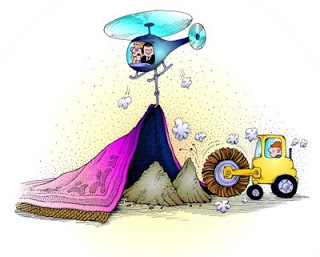
How should we judge a government?

In Malaysia, if you don't watch television or read newspapers, you are uninformed; but if you do, you are misinformed!

"If you're not careful, the newspapers will have you hating the people who are being oppressed, and loving the people who are doing the oppressing." - Malcolm X

Never argue with stupid people, they will drag you down to their level and then beat you with experience - Mark Twain

Why we should be against censorship in a court of law: Publicity is the very soul of justice … it keeps the judge himself, while trying, under trial. - Jeremy Bentham

"Our government is like a baby's alimentary canal, with a happy appetite at one end and no
responsibility at the other. " - Ronald Reagan

Government fed by the people

Government fed by the people

Career options

Career options
I suggest government... because nobody has ever been caught.

Corruption so prevalent it affects English language?

Corruption so prevalent it affects English language?
Corruption is so prevalent it affects English language?

When there's too much dirt...

When there's too much dirt...
We need better tools... to cover up mega corruptions.

Prevent bullying now!

Prevent bullying now!
If you're not going to speak up, how is the world supposed to know you exist? “Orang boleh pandai setinggi langit, tapi selama ia tidak menulis, ia akan hilang di dalam masyarakat dan dari sejarah.” - Ananta Prameodya Toer (Your intellect may soar to the sky but if you do not write, you will be lost from society and to history.)

Tuesday, April 11, 2017

Cassandra Hsiao's essay which helps her to win offers from Ivy League universities

In our house, English is not English. Not in the phonetic sense, like short a is for apple, but rather in the pronunciation – in our house, snake is snack. Words do not roll off our tongues correctly – yet I, who was pulled out of class to meet with language specialists, and my mother from Malaysia, who pronounces film as flim, understand each other perfectly.
In our house, there is no difference between cast and cash, which was why at a church retreat, people made fun of me for “cashing out demons.” I did not realize the glaring difference between the two Englishes until my teacher corrected my pronunciations of hammock, ladle, and siphon. Classmates laughed because I pronounce accept as except, success as sussess. I was in the Creative Writing conservatory, and yet words failed me when I needed them most.
Suddenly, understanding flower is flour wasn’t enough. I rejected the English that had never seemed broken before, a language that had raised me and taught me everything I knew. Everybody else’s parents spoke with accents smarting of Ph.D.s and university teaching positions. So why couldn’t mine?
My mother spread her sunbaked hands and said, “This is where I came from,” spinning a tale with the English she had taught herself.
When my mother moved from her village to a town in Malaysia, she had to learn a brand new language in middle school: English. In a time when humiliation was encouraged, my mother was defenseless against the cruel words spewing from the teacher, who criticized her paper in front of the class. When she began to cry, the class president stood up and said, “That’s enough.”
“Be like that class president,” my mother said with tears in her eyes. The class president took her under her wing and patiently mended my mother’s strands of language. “She stood up for the weak and used her words to fight back.”
We were both crying now. My mother asked me to teach her proper English so old white ladies at Target wouldn’t laugh at her pronunciation. It has not been easy. There is a measure of guilt when I sew her letters together. Long vowels, double consonants — I am still learning myself. Sometimes I let the brokenness slide to spare her pride but perhaps I have hurt her more to spare mine.
As my mother’s vocabulary began to grow, I mended my own English. Through performing poetry in front of 3000 at my school’s Season Finale event, interviewing people from all walks of life, and writing stories for the stage, I stand against ignorance and become a voice for the homeless, the refugees, the ignored. With my words I fight against jeers pelted at an old Asian street performer on a New York subway. My mother’s eyes are reflected in underprivileged ESL children who have so many stories to tell but do not know how. I fill them with words as they take needle and thread to make a tapestry.
In our house, there is beauty in the way we speak to each other. In our house, language is not broken but rather bursting with emotion. We have built a house out of words. There are friendly snakes in the cupboard and snacks in the tank. It is a crooked house. It is a little messy. But this is where we have made our home.
Essay taken from tab.com
Pang Ven Xhin has this to say:

Sorry, Malaysia—You Don't Get To Be Proud Of Cassandra Hsiao's Success

"Here are some facts about Cassandra Hsiao, in case you’ve never heard of her.
  • This year, she was accepted into all 8 Ivy League universities in America, a very impressive feat for any student.
  • At the age of 5, she moved to America with her family.
  • She’s a kickass writer, with an impressive set of accomplishments (besides writing the essay that got her all those acceptance letters, she’s a very active student journalist who has interviewed quite a few celebrities, has written stage plays and she produces videos on her own YouTube channel).
Before I continue, let me clarify. I am not diminishing her successes.
Her school can be proud of Cassandra. Her family can be and probably is very proud of Cassandra. Whoever’s had a hand in shaping, mentoring and supporting Cassandra can be proud of Cassandra.
Heck, Cassandra should be proud of Cassandra. She didn’t get where she is now without a lot of hard work and dedication to pursue her interests and hone her skills.
However, I feel Malaysians have no right in making a big deal out of her particularly over the “fact” that she is a Malaysian who has succeeded. We might as well make a big deal out of  Ifeoma White-Thorpe or Martin Altenburg, two other American teens who also swept the Ivy 8.

Link

Wednesday, April 05, 2017

Snopes dispel reports which claimed chemotherapy doesn't work

I hope cancer survivors, like myself, are not discouraged by various reports which claimed chemotherapy doesn't work. One of which is this, by Dr. Hardin Jones :

"People who refuse chemotherapy treatment live on average 12 and a half years longer than people who undergo chemotherapy, says Dr. Jones.
According to recent statistics, approximately 1 in 2 men and 1 in 3 women will develop cancer in their lifetimes. This saddening reality is made worse when it is acknowledged that modern methods of ‘treating’ the disease are often ineffective and only make the symptoms of the disease worse. In fact, according to one Berkeley doctor, chemotherapy doesn’t work 97% of the time.
In the eye-opening video above, Dr. Hardin B. Jones, a former professor of medical physics and physiology at the University of California, Berkeley, discusses how ‘leading edge’ cancer treatment is a sham.
He has personally studied the life expectancy of patients for more than 25 years and has come to the conclusion that chemotherapy does more harm than good. The bone-chilling realization prompted Dr. Jones to speak out against the billion-dollar cancer industry.
“People who refused chemotherapy treatment live on average 12 and a half years longer than people who are undergoing chemotherapy,” said Dr. Jones of his study, which was published in the New York Academy of Science.
“People who accepted chemotherapy die within three years of diagnosis, a large number dies immediately after a few weeks.”
According to the physician, the only reason doctors prescribe chemotherapy is because they make money from it. Such an accusation doesn’t seem unreasonable, as cancer treatment runs, on average, between $300,000 — $1,000,000 per treatment."

According to snopes.com:

Excerpt: Is any of this true? First off, as David Gorski wrote for Science-Based Medicine, such claims about chemotherapy by alternative medicine practitioners and aficionados are quite common and are typically misleadingly based on cherry-picked statistics, misunderstandings (or misrepresentations) of how chemotherapy works, and a focus on chemotherapy’s very visible drawbacks rather than its (less-obvious) successes:

If there’s one medical treatment that proponents of “alternative medicine” love to hate, it’s chemotherapy. Rants against “poisoning” are a regular staple on “alternative health” websites, usually coupled with insinuations or outright accusations that the only reason oncologists administer chemotherapy is because of the “cancer industrial complex” in which big pharma profits massively from selling chemotherapeutic agents and oncologists and hospitals profit massively from administering them. Usually, they boil down to two claims: (1) that chemotherapy doesn’t work against cancer (or, as I’ve called it before, the “2% gambit“) and (2) that the only reason it’s given is because doctors are brainwashed in medical school or because of the profit motive or, of course, because of a combination of the two. Of course, the 2% gambit is based on a fallacious cherry picking of data and confusing primary versus adjuvant chemotherapy, and chemotherapy does actually work rather well for many malignancies, but none of this stops the flow of misinformation.
Chemotherapy, not surprisingly, is easy to demonize. There are few treatments that cause such odious side effects, and when taken to its fullest extreme, such as complete ablation of a cancer patient’s bone marrow in preparation for a bone marrow transplant, chemotherapy can be brutal. It’s also true that for advanced solid malignancies, it only tends to produce palliation or a prolongation in survival, not a cure, and people with cancer want a cure. Palliation just isn’t that appealing, for obvious reasons. When people think of chemotherapy, they think of hair falling out, nausea and vomiting, fatigue, and death. Since chemotherapy is often given for more advanced malignancies, it’s sometimes hard to tell how many of these symptoms (other than the hair loss) are due to the cancer and how much they are due to side effects of the chemotherapy, and many people incorrectly blame chemotherapy for the deaths of their loved ones with cancer. Also, because, like radiation therapy, chemotherapy is often given in the adjuvant setting (i.e., in addition to curative surgery in order to decrease the risk of recurrence and death), it’s very easy to produce stories in which people with cancer refuse chemotherapy and/or radiation therapy after surgery and attribute their survival not to the conventional therapy (surgery) but to whatever quackery they chose to use. When used in early stage cancer, although its relative efficacy can seem large, for example a 30% decrease in the risk of dying, if the risk of dying of cancer is only 10% to begin with, that’s only a 3% survival benefit on an absolute basis.
In reality, the use of alternative medicine instead of effective treatment for cancer, where it’s been studied, is always associated much poorer survival, even in pancreatic cancer, for which conventional treatments don’t do so well. Still, among the treatments in the “cut, poison, burn” terminology that believers in alternative medicine like to use to describe conventional cancer therapy, it is the “poison” that causes the most fear and is most viciously demonized in the alt-med “literature.”
Link

Monday, April 03, 2017

My take on EPF contributors' situation while they are members

EPF lost RM203m from FGV stock investments

Read the article in Malaysiakini: https://www.malaysiakini.com/news/377857

My comment in Facebook on Feb 20, 2017 over EPF's book loss:

Recent accounts show > Rm8 billions book loss in share investments. Meant for long term investments, recent divestment in FGV shares shows the high risks, especially those based on political decisions rather than guided by strict guidelines as trustees of public funds. As long as EPF is able to maintain decent annual dividends and its total assets exceed total contributions, it can still get away with unwise investments and loans to unreliable entities. To the individual contributor, he or she is concerned with security of contributions. Whether EPF makes tons of money or book losses will not affect him or her, as it will be carried forward annually and indefinitely. The real problem will only arise when it is insolvent and unable to meet demands for withdrawals by all contributors. Meantime, government of the day has leeway to manipulate when necessary.

To the average contributors, whether EPF made lots more money will not affect them, unless and until it decides to liquidate the fund and distribute to all contributors, which is so unlikely. If they are lucky, they get higher dividends over the years as members. Contributors come and go: as first time members until final withdrawals from the balances due to them.

Link

Thursday, March 30, 2017

The standard of our Parliamentary debate

Compare and contrast the speeches by YB Rafizi Ramli (Pandan) and YB Che Mohamad Zulkifly Jusoh (Setiu). Rafizi's is clear, concise and relevant, while that of Che Mohamad Zulkifly is mainly personal attack and irrelevant...


Link

Monday, March 20, 2017

Dr Josh Axe: Vitamin B17 Controversy: Poison or Cancer Treatment?

Excerpt:

"Banned by the FDA in the 1980s but touted by some alternative medicine practitioners as a treatment for cancer, the controversy over the innocently named vitamin B17 rages on. Once labeled and marketed as a vitamin, its appearance practically disappeared without a trace within the mainstream medical community.
Today, however, a simple Web search pulls multiple blogs and articles either generously supporting this nutrient as a miracle cure or vilifying it as a hoax.
Vitamin B17, also called amygdalin or laetrile, is a glycoside nutrient linked with cancerprevention in alternative medicine practices — and there are anecdotal claims that it’s actually cured cancer. Vitamin B17 is derived from natural food sources and most abundant in seeds of plants of the prunasin family, such as apricots and apples.
Vitamin B17 interacts with other antioxidants — including vitamin Avitamin C and vitamin E — along with pancreatic enzymes to break down and eliminate harmful cells from the body. This makes it beneficial for detox support, immunity and potentially even various forms of disease prevention.
Vitamin B17, which has the scientific name mandelonitrile beta-D-gentiobioside, is considered a nitriloside, a natural cyanide-containing substance. Laetrile, the extract form of vitamin B17, is most well-known for potentially helping prevent cancer development through the production of hydrogen cyanide.
This beneficial compound is released into the body’s tissues and targets and destroys mutated cells. Although more formal research is still needed to prove vitamin B17’s effectiveness, many alternative medicine practitioners use vitamin B17 to increase immunity. Cyanide is thought to be the main anti-cancer component of vitamin B17 but is not fully proven in clinical settings as of today.

Vitamin B17’s Potentially Big Benefits

1. May Help Protect Against Cancer

Overall, study results investigating the anti-cancer effects of vitamin B17 are mixed. Some show that vitamin B17 is beneficial in avoiding cancer and keeping the spread of existing cancer cells to a minimum, while others show no effects of vitamin B17 on cancerous cells. While many practitioners believe that vitamin B17 laetrile is a very good cancer treatment, most agree that it shouldn’t be the primary cancer treatment for any patient — instead, they recommend that it be used as an effective add-on supplement.
Vitamin B17, specifically in the form of D-amygdalin, may help with the regression and growth of cancerous cells and tumors because it exhibits selective killing effects on mutated cells, also called apoptosis. Apoptosis is a mechanism of “programmed cell death” and considered an important part of cancer treatment. Vitamin B17 compounds have the important ability to kill cancer cells more readily than killing normal, healthy cells.
In a study by the Department of Physiology at Kyung Hee University in South Korea, when amygdalin extract was combined with cancerous human prostate cells, the extract helped significantly induce apotosis in the prostate cancer cells. The researchers conclude that amygdalin may offer a valuable, natural option for treating prostate cancer. (1)
Other animal studies show that vitamin B17 amygdalin is effective at killing cancerous bladder and brain cells under certain conditions, especially when combined with other antibody-enzyme complexes. (2)
On the other hand, other studies using human lung and breast cancer cells show no effects of vitamin B17 on stunting tumor growth. Therefore, in the medical community, there still isn’t agreement at this time as to whether vitamin B17 should be used as an anti-cancer treatment.

2. Boosts Immunity

Vitamin B17 contains special properties that slow down the spread of illness throughout the body by killing harmful cells, but the exact way that vitamin B17 does this isn’t well-understood.
A study published in the International Journal of Radiation and Biology found that vitamin B17 amygdalin stimulated the immune system by causing a statistically significant increase in the ability of a patient’s white blood cells to attack harmful cells. (3) One theory of vitamin B17’s effects suggests that transformation of normal cells into dangerous cells that can cause disease is normally prevented by beneficial enzymes produced within the pancreas. So vitamin B17 may help increase the production of pancreatic enzymes that destroy harmful properties within the body.
Vitamin B17 is also thought to help the body experience enhanced detox effects by supporting liver function. This boosts immune function by ridding the body of toxins, malignant cells and other potentially harmful substances before they cause illness or serious chronic diseases. Another explanation of vitamin B17 mechanisms is that when vitamin B17 releases cyanide, it increases the acid content of tumors and leads to the destruction of harmful cells within the tumors, arresting their growth.

3. Reduces Pain

In a case series published in 1962, when patients were treated with a wide range of doses of intravenous vitamin B17 laetrile, pain relief was the primary benefit reported. Some of the patients’ responses included decreased adenopathy (swollen lymph nodes) and decreased tumor size.
However, patients weren’t followed long term to determine whether or not the benefits continued after treatment stopped, so it’s hard to tell whether vitamin B17 could act as a natural pain reliever for other conditions, such as arthritis. (4)

4. Lowers High Blood Pressure

Vitamin B17 may cause a low blood pressure reaction due to formation of thiocyanate, a powerful blood pressurelowering agent. However, it’s unknown if this is an effective treatment long-term or if the effects are mostly temporary.
Once metabolized, vitamin B17 causes enzyme beta-glucosidase production that interacts with intestinal bacteria to detox the body and lower blood pressure. This normally isn’t a danger for most people and may be beneficial for some, but it’s important not to use vitamin B17 in this way if you already take blood pressure-lowering medication.
If you have any existing heart issues that could become complicated if you experienced a sudden drop in blood pressure, you should avoid taking vitamin B17."
Also mentioned in the article:

Is Vitamin B17 Safe?

Best Sources of Vitamin B17

Is Vitamin B17 Treatment New?

Recommended Intake of Vitamin B17

Types of Vitamin B17 Supplements

Vitamin B17 Recipes

Vitamin B17 Side Effects and Interactions


Link