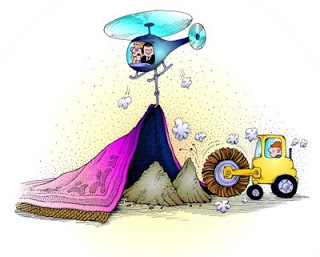
How should we judge a government?

In Malaysia, if you don't watch television or read newspapers, you are uninformed; but if you do, you are misinformed!

"If you're not careful, the newspapers will have you hating the people who are being oppressed, and loving the people who are doing the oppressing." - Malcolm X

Never argue with stupid people, they will drag you down to their level and then beat you with experience - Mark Twain

Why we should be against censorship in a court of law: Publicity is the very soul of justice … it keeps the judge himself, while trying, under trial. - Jeremy Bentham

"Our government is like a baby's alimentary canal, with a happy appetite at one end and no
responsibility at the other. " - Ronald Reagan

Government fed by the people

Government fed by the people

Career options

Career options
I suggest government... because nobody has ever been caught.

Corruption so prevalent it affects English language?

Corruption so prevalent it affects English language?
Corruption is so prevalent it affects English language?

When there's too much dirt...

When there's too much dirt...
We need better tools... to cover up mega corruptions.

Prevent bullying now!

Prevent bullying now!
If you're not going to speak up, how is the world supposed to know you exist? “Orang boleh pandai setinggi langit, tapi selama ia tidak menulis, ia akan hilang di dalam masyarakat dan dari sejarah.” - Ananta Prameodya Toer (Your intellect may soar to the sky but if you do not write, you will be lost from society and to history.)

Friday, October 09, 2015

On Wills and other documentations : How women lost out in the past... and still do... in marriage certificates

From openDemocracy:

Documenting women’s lives: mothers' names on marriage certificates

LAUREN JOHNSON 5 October 2015

In England and Wales in the twenty-first century we continue to perpetuate a system that writes women out of our collective history, and we are all poorer for it.

Her name was Thomasine Bonaventure. She grew up in Cornwall, then – like so many, before and since – she went to seek her fortune in London. She married three times, each time to a tailor of the city. Every time one of her husbands died she took over his business for a time, and on her third husband’s death she devoted the rest of her life to training up apprentices, educating a handful of disadvantaged children in her home and founding a school back in Cornwall. She was not only tremendously capable, but also a little showy in her good fortune, travelling the streets of London swathed in rich gowns and riding a horse decked out in blue velvet.

We know this much about Thomasine because before she died in 1512 she wrote a will in which her charitable work, her business and educational endeavours, and her husband's are all mentioned. Other documents help to fill the gaps that remain: the wills of those husbands, the royal licence for her education foundation, the records kept by the crafts of which her husbands, their apprentices and even Thomasine herself were members. In short, like all historical figures, our knowledge of Thomasine is a product of the paper trail she left behind.

But this paper trail would have been considerably fainter had Thomasine died a wife rather than a widow. Since a wife was the property of her husband, she was not permitted to write a will without her husband’s permission. As a result, far more men’s wills survive than women’s. It is very likely that Thomasine’s last husband Sir John Percyvale owed his swift rise to preeminence in the Merchant Taylors Guild and the City of London to his marriage, riding his wife’s coat-tails into the tailoring community. Yet if they worked together during John’s life – if they made decisions about their trade as a couple, if they co-tutored their apprentices, if they bought homes and furnishings and hired servants in consultation with one another, or even if Thomasine expressly dominated their decision-making process – we do not know it. Documents have serious limitations, particularly when it comes to charting the lives of women in the past.

More:
https://www.opendemocracy.net/5050/lauren-johnson/documenting-womens-lives-%E2%80%A8mothers-names-on-marriage-certificates
Link

Wednesday, October 07, 2015

Why sue Tun Dr Ling and not Tun Dr Mahathir?

It is pretty obvious to most people the reason why. In case anyone who is reading this does not know (there are foreigners reading too), Dr Mahathir served longest as PM of Malaysia - 22 years! No mean feat by any standard. He had been called a dictator by many and it is surprising why he did not continue to serve until now and make it 34 years. This is because before he gave up the post of PM, he was instrumental in deciding on Pak Lah as his successor, and subsequently, on Najib to replace Pak Lah.

But what he did not realise was the difference between Pak Lah and Najib: sensitive and insensitive. Put to pressure for great loss in GE12, Pak Lah resigned without complaining. Najib, on the other hand, till today does not do as told by his mentor and benefector even though he was hinted at, then told directly to his face, and now being called names like 'thief', which incidentally is more or less what Dr Ling had said - that he took people's money and put into his account.

Legal action against Dr Ling was swift after the statement was made. His wife already received a letter from Najib's lawyers which demanded an apology, if not, legal action wll be instituted.

Who is Tun Dr Ling to expect the same 'immunity' like Tun Dr Mahathir from PM Dato Seri Najib Tun Razak?

Dr Ling used to be President of MCA, an erstwhile strong coalition partner in Alliance, then a dispensable one in Barisan Nasional. MCA has been told to leave by certain Umno leaders for voicing out against Najib.

At 90, Dr Mahathir found out too late that the rules he had set in Umno to protect himself as President against opponents, are also protecting the very President he has been trying to dislodge as PM.

Tun Dr Mahathir is still being respected as an elder statesman, and many who were at the receiving end of his criticisms had to take them without any form of retaliation. But for how long? There is always a first time, that he might be arrested and even jailed, for openly telling the people to vote against Najib in Parliament.

It will be interesting if Tun Dr Mahathir, the founding architect of Umno Baru, who holds membership No.0000001, was sacked from the party.

Many would have forgotten Dr Ling had been a saviour when Umno morphed into Umno Baru, and Dr Mahathir has been ever grateful to him. He was BN Chairman for one day to make the legal process possible! It is a no brainer how ROS went out of its way to help, by facilitating the process. Compare and contrast that with its treatment against opposition party DAP in particular, and Pakatan Rakyat in general.
Link

Tuesday, October 06, 2015

Julia Yeow: 3 Lessons BN should learn from PAP

Before I post the excerpt from the article in The Malaysian Insider, I must say I find the title condescending, if not insulting to Umno-led Barisan Nasional. It is not that we do not know what needs to be done, but no way we are going to take lessons from PAP!

Excerpt:

‘Performance legitimacy’

'Despite the incumbency factor, which was working against the PAP, the leadership’s perceived integrity and efficiency won over not only a generation of older loyalists, but also the younger and more critical Singaporeans.

When Prime Minister Lee Hsien Loong said he would step down after the next elections, he took steps to put his retirement into place less than a month after celebrating a strong election victory.

Singaporeans know exactly what to expect when it comes to voting in PAP, and it’s simply a matter of whether or not they agree with their policies.'

Zero-tolerance for corruption and money politics

At a forum last week in Kuala Lumpur, former Singapore high commissioner to Malaysia K. Kesavapany told delegates that one strong factor leading to PAP’s strong performance in the last elections was the party’s culture of zero-tolerance for corruption.

“We’re not saying there is absolutely no corruption, but it happens at the lower levels, the officers,” Kesavapany said.

“At the leadership level, I think it’s safe to say almost every Singaporean – even the opposition – believes that the PAP is corrupt-free.

“We have also abhorred money politics right from the start… it’s simply not in our culture.”

Keeping politics free from race, religion and language

'The final, and most outstanding, legacy and practice of the PAP leadership is the exclusion of race, religion and language from politics.

This culture has been in place since the birth of the nation and has resulted in a genuine sense of shared responsibility and national pride by the vast majority of its population, including the minority ethnic groups.

“There is a need to ensure every citizen feels that he or she is fairly treated and that there is no inherent advantage or disadvantage on account of one’s race, religion or language,” said Tan.

Even with a 70% ethnic Chinese-dominated society, voter discontent in Singapore rarely stems from racial issues and policies, but rather from problems affecting quality of life and economic position – simply put, issues that transcend race and religion.'

- See more at: http://www.themalaysianinsider.com/opinion/julia-yeow/article/3-lessons-bn-should-learn-from-pap#sthash.vwQFKuiB.dpuf
Link

Monday, October 05, 2015

Why not cut ties with China?

Let's not talk about China's current economic power and prowess as well as military might. It is obvious that China has grown to become a powerful economic and military giant (instead of just the world's most populated country), capable of helping third world countries, especially those in Africa, in infra-structures and economic development. In terms of wealth, it is also the biggest creditor to even USA!

To the ordinary Chinese in Malaysia, China is just another country whose people happen to be of the same race. Those born in China and became Malaysian citizens are dwindling in numbers because of natural death. Majority of Chinese Malaysians are born here and have no connections with their relatives (if any) in China. So it is illogical to tell them to 'go back to China' when they are not even citizens of China! My late father, born in Malaya in 1909, had never been to China. Despite ease of modern air travel, I had not been to China nor Taiwan, despite having lived in UK for a few years.

The Chinese in Malaysia are quite contented to be able to do their own things, like sending their children to Chinese schools as an option, carry on their own businesses, and get involved in politics if they are so inclined. Just because DAP is now more successful than MCA, Umno in particular seems to view it as a threat to their continued hold on to power. This could be true, but definitely not in the sense that the Chinese will control the country nor that a Chinese will be Prime Minister. The demography just does not support this, and it is Umno, which feels threatened, which is using race, religion and royalty to frighten the Malay populace to continue supporting it. Even if the opposition were to rule, and DAP's candidates won all the allocated seats, it is impossible for it to have majority in Parliament. In the last GE, DAP contested only 51 (out of 222) parliamentary seats and 102 (out of 505) state seats. Compare this with PKR's 99 and 172, and PAS's 73 and 237, respectively.

That we only have a Chinese Chief Minister in Penang and already some Malays are uncomfortable with it (to put it mildly), what is the point of arguing whether the Constitution allows a Chinese to be PM? As it is, almost all heads of government departments, institutions, universities and even city mayors are Malays. Was there any demonstration or protest by the Chinese against such obvious Malay monopoly? I believe many Chinese would not care if Chinese in MCA or Gerakan were given ministerial posts.

Have the Malays been too sensitive to anything remotely suggesting cooperation of China and Chinese Malaysians?

According to a recent report in The Star:

'In an interview on Wednesday, Dr Huang said his visit to Petaling Street (also known as Chinatown) and statements made there had been taken out of context and misinterpreted.

After the walkabout, during which he distributed mooncakes, a reporter asked Dr Huang a hypothetical question: “If there were a massive anti-Chinese riot in Malaysia, would the Chinese government interfere?”

“I told him I could only give a general and standard diplomatic reply without mentioning Malaysia,” said the envoy.

“And I said: ‘The Chinese government has always pursued peaceful co-existence and non-interference in the internal affairs of other countries. But if such a situation occurs, and it affects Chinese interests, Chinese people and Chinese enterprises, undermines good diplomatic ties, China will not sit idle. For the past 66 years, our diplomats have been repeating this statement. It is our universal value.’

“I also said that we oppose extremism, racism and terrorism in any form. We also oppose any disruption to public order.”

Rest of the report:
http://www.thestar.com.my/Opinion/Columnists/One-Mans-Meat/Profile/Articles/2015/10/03/When-China-sneezes-Malaysia-coughs-While-some-stress-on-noninterference-others-say-China-is-a-superp/

Many Chinese Malaysians are wondering why our leaders welcome China's investments and tourists, but treat the locals with disdain, with calls for them to 'get out of the country if they did not like the political system' or 'go back to China' and calling us names like 'cina babi' and so on. We have feelings too. There were calls to close down SJKC when non-Chinese in those schools comprise 13% and increasing! Surely it must be the higher standard of education or better prospects with knowledge of Chinese language which attract them.

Why not cut diplomatic ties with China, and prevent them from investing in or visiting Malaysia? What's the point of having a 'China-Malaysia Friendship Garden in Putrajaya' when China's ambassador is not even treated with the right protocol or at least some respect?

To quote Wong Chun Wai in his recent article, Let cool heads prevail:

'Let’s be blunt. We need China but China does not really need us. We are just a small country but we have been lucky because of our historic ties and also the far-sightedness of the late Tun Abdul Razak who forged official ties with China.

More importantly, Malaysia, with its huge Malaysian Chinese community, has been able to cement the economic relations with China because we understand the Chinese language and culture – putting us above other Asean competitors except Singapore.

This is an asset because when we are able to speak Chinese, we win the minds and hearts of the mainlanders.

This is not something to politicise. And we should be thankful that the Chinese schools have been guaranteed a place in our education system.'

More:
http://www.thestar.com.my/Opinion/Columnists/On-The-Beat/
Link

Saturday, October 03, 2015

Customs tell businesses: Don't use GST as excuse

I wish to refer to the news report in Malay Mail:
http://www.themalaymailonline.com/malaysia/article/dont-use-gst-as-excuse-to-shutter-customs-tell-businesses

Now that the GST has been in force, we can leave out the pros and cons of having it. But to deny that GST has affected small businesses and even accuse them of using it as an excuse to shut down businesses is rubbing salt to injury.

Just imagine the number of small businesses, especially family-run ones like sundry shops, which were affected by the introduction of GST, and the dilemma they were in: to continue or to shut down, is so real.

To continue would mean a revamp of many years of trading practices, with the introduction of computerized point of sale and accounting. Even with much publicity (though its value in terms of answering questions left much to be desired, simply because of the use of too simplistic examples), government incentives like free seminars, business people are left with the choice of closing down or increase overheads of tens of thousands per year. Computers cost money, so does software that goes with them, plus the extra accounting charges. Of course, it would improve overall management of the business, but to someone who knows next to nothing of such new technology, it causes sleepless nights when pondering over the dilemma, as well as soon after using it.

To some seniors whose children are already into other jobs or professions, GST is like a tipping point to closing down their businesses, with a heavy heart. Who would like to be forced into making such a decision?

GST, as we have experienced since its introduction, has caused an overall increase in prices of goods and services. Never mind the simplistic explanations showing how little the effects of the tax, but everything has gone up. Some unregistered traders and coffee shop stalls have to face angry customers asking for printed bills when their prices were upped because of increases in costs of ingredients, whether they were due to GST or otherwise.

I know of someone who runs a shop trading in electrical goods. He had sleepless nights trying to understand the new software that comes with GST. Having been in the trade for many years, he said that for doing the same business, besides the initial costs of equipment, he now has to pay more than Rm10,000 in extra costs for having the system.

Costs increase across the board, whether because of GST or otherwise. How could the government control prices when the causes are numerous and hard to identify and quantify? Any strict action according to the law will affect only a very small number of unfortunate businesses without really solving the problem. But it would help if the Customs would be more sympathetic than accusing those who closed down their businesses as using GST as an excuse. It was not an excuse but a real problem which forced some to do so.
Link