Sacred Tears of a Woman
A little boy asks his mother: “Why do you cry?”
“Because I am a woman.” she answers.
“I don't understand” he says.
His mother hugs him and says, “and you never will.”
Later, the little boy asks his father: “Why does mommy cry?”
“All women cry for no reason” he says, is all that his father could answer him.
When he became an adult, he asked God: God, why do women cry so easily?”
“When I created woman, she needed to be special.”
“I created her shoulders strong enough to bear the weight of the world...and soft enough to be comfortable.”
“I gave her the strength to give life, the kind that accepts the rejection that often comes from children.”
“I gave her the strength to allow her to go on when everybody else gives up.”
“The kind that takes care of her family, despite illness and fatigue.”
“I gave her the sensitivity to love her children unconditionally, even when they have hurt her deeply.”
“I gave her the strength to endure her husband in his faults...
And to stay at his side without weakening.”
“And finally I gave her tears to shed whenever she needs them to be shed.”
“You see, my son, the beauty of a woman is not in the clothes she wears, nor is it in her face or in the way she does her hair.”
“The beauty of a woman resides in her eyes. It is the door to her heart, the door where Love resides...
And it is often through her tears that you see her heart goes by.”
Before anyone asks, I would like to comment that this is just a priest or pastor's version, as I cannot see how anyone could have communicated with Him, unless in a dream and it is believed to be true.
But I would readily agree that women in general are special in their role as mothers in being selfless and unconditional towards their children.
But wait a minute, there are exceptions, ok? I have come across live examples of mothers who are just the opposite of the above description. Like this one for example:
MANY REASONS I OWE MY MOTHER (read secret tears of a child):
My mother taught me TO APPRECIATE A JOB WELL DONE .
"If you're going to kill each other, do it outside. I just finished cleaning."
My mother taught me RELIGION. "You better pray that will come out of the carpet."
My mother taught me about TIME TRAVEL .
"If you don't straighten up, I'm going to knock you into the middle of next week!"
My mother taught me LOGIC. "Because I said so, that's why."
My mother taught me MORE LOGIC.
"If you fall out of that swing and break your neck, you're not going to the store with me.."
My mother taught me FORESIGHT.
"Make sure you wear clean underwear, in case you're in an accident."
My mother taught me IRONY. "Keep crying, and I'll give you something to cry about."
My mother taught me about the science of OSMOSIS. "Shut your mouth and eat your supper."
My mother taught me about CONTORTIONISM.
"Will you look at that dirt on the back of your neck!"
My mother taught me about STAMINA.... "You'll sit there until all that spinach is gone."
My mother taught me about WEATHER.
"This room of yours looks as if a tornado went through it."
My mother taught me about HYPOCRISY.
"If I told you once, I've told you a million times. Don't exaggerate!"
My mother taught me the CIRCLE OF LIFE.
"I brought you into this world, and I can take you out."
My mother taught me about BEHAVIOUR MODIFICATION. "Stop acting like your father!"
My mother taught me about ENVY.
"There are millions of less fortunate children in this world who don't have wonderful parents like you do."
My mother taught me about ANTICIPATION. "Just wait until we get home."
My mother taught me about RECEIVING . "You are going to get it when you get home!"
My mother taught me MEDICAL SCIENCE..
"If you don't stop crossing your eyes, they are going to freeze that way."
My mother taught me ESP. "Put your sweater on; don't you think I know when you are cold?"
My mother taught me HUMOUR.
"When that lawn mower cuts off your toes, don't come running to me."
My mother taught me HOW TO BECOME AN ADULT .
"If you don't eat your vegetables, you'll never grow up."
My mother taught me GENETICS. "You're just like your father."
My mother taught me about my ROOTS.
"Shut that door behind you. Do you think you were born in a barn?"
My mother taught me WISDOM. "When you get to be my age, you'll understand."
My mother taught me about JUSTICE.
"One day you'll have kids, and I hope they turn out just like you.
Link
Government fed by the people

Career options

I suggest government... because nobody has ever been caught.
Corruption so prevalent it affects English language?

Corruption is so prevalent it affects English language?
When there's too much dirt...
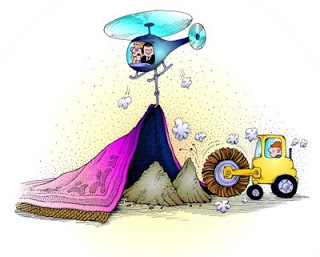
We need better tools... to cover up mega corruptions.
Prevent bullying now!

If you're not going to speak up, how is the world supposed to know you exist? “Orang boleh pandai setinggi langit, tapi selama ia tidak menulis, ia akan hilang di dalam masyarakat dan dari sejarah.” - Ananta Prameodya Toer (Your intellect may soar to the sky but if you do not write, you will be lost from society and to history.)
Thursday, July 23, 2009


Prof. Jonathan Zittrain and the unsung internet heroes
Crack teams of volunteers keep the net online and functioning, according to leading internet lawyer Jonathan Zittrain of Harvard University.
The way data is divided up and sent around the internet in many jumps makes it "delicate and vulnerable" to attacks or mistakes, he said. However, he added, the "random acts of kindness" of these unsung heroes quietly keep the net in working order.
Professor Zittrain's comments came at the TED Global conference in Oxford. Incidents such as when the Pakistan government took YouTube offline in 2008 exposed the web's underlying fragility, he explained.
But a team of volunteers - unpaid, unauthorised and largely unknown to most people - rolled into action and restored the service within hours.
"It's like when the Bat signal goes up and Batman answers the call," Professor Zittrain told BBC News.
Blind faith
The fragility of the internet's architecture was largely due to its origins, said Professor Zittrain. He said it had been conceived with "one great limitation and with one great freedom". "Their limitation was that they didn't have any money," he told the TED audience in Oxford.
"But they had an amazing freedom, which was that they didn't have to make any money from it.
"The internet has no business plan - never did - no CEO, no single firm responsible for building it. Instead it's folks getting together to do something for fun, rather than because they were told to or because they were expecting to make money from it," he said.
That ethos, he suggested, had led to a network architecture that was completely unique.
"As late as 1992, IBM was known to say that you couldn't build a corporate network using internet protocol."
Internet protocol (IP), the method used to send data around the internet, was first described by Vint Cerf and Bob Kahn in 1974. Data is broken into chunks - or packets - sent around different parts of the network, often owned by different corporations and entities.
Professor Zittrain likened it to how a drink may be passed along a row of people at a sporting event.
"Your neighbourly duty is to pass the beer along - at risk to your own trousers – to get it to its destination."
"That's precisely how packets move around the internet, sometimes in as many as 25 or 30 hops with the intervening entities passing the data around having no contractual or legal obligation to the original sender or to the receiver."
The route the data takes depends on the net's addressing system, he said.
"It turns out there is no overall map of the internet. It is as if we are all sat together in a theatre but we can only see in the fog the people around us.
"So what do we do to figure out what is around us. We turn to the person on our right and tell them what we can see to the left and vice versa. This method, he said, gives network operators a general sense of "what is where".
"This is a system that relies on kindness and trust, which also makes it very delicate and vulnerable," he said.
"In rare but striking instances, a lie told by a single entity within this honeycomb can lead to real trouble."
Bucket brigade
One example, he said, was an incident in 2008 when Pakistan Telecom accidentally took YouTube offline. At the time, the Pakistan government asked Pakistan's ISPs to block the site, reportedly because of a "blasphemous" video clip.
However, a network error caused a worldwide blackout of the site. "This one ISP in Pakistan decided to [institute] the block for its subscribers in a highly unusual way," said Professor Zittrain. "It advertised that … it had suddenly awakened to find it was YouTube."
Because of the way that the network spreads messages between neighbours, the announcement quickly reverberated around the world.
Within two minutes, YouTube was completely blocked. "One of the most popular websites in the world, run by the most powerful company in the world, and there was nothing that YouTube or Google were particularly privileged to do about it," said Professor Zittrain.
However, he said, the problem was fixed within about two hours.
This was down to a largely unknown group known as the North American Network Operators Group (NANOG), he said. NANOG is a forum for distributing technical information among computer and network engineers. "They came together to help find a problem and fix it," he said.
Despite being unpaid volunteers they were able to put YouTube back on line, he said.
"It's kind of like when your house catches on fire," he said. "The bad news is there is no fire brigade. The good news is that random people appear from nowhere, put out the fire and leave without expecting payment or praise."
The same social structures - and in particular kindness and trust - are also responsible for websites such as Wikipedia, he said.
"It's like dark matter in the universe. There's a lot of it, you don't see it but it has a huge impact on the physics of the place," he earlier told the BBC.
This year's TED Global conference runs from 21 to 24 July.
The way data is divided up and sent around the internet in many jumps makes it "delicate and vulnerable" to attacks or mistakes, he said. However, he added, the "random acts of kindness" of these unsung heroes quietly keep the net in working order.
Professor Zittrain's comments came at the TED Global conference in Oxford. Incidents such as when the Pakistan government took YouTube offline in 2008 exposed the web's underlying fragility, he explained.
But a team of volunteers - unpaid, unauthorised and largely unknown to most people - rolled into action and restored the service within hours.
"It's like when the Bat signal goes up and Batman answers the call," Professor Zittrain told BBC News.
Blind faith
The fragility of the internet's architecture was largely due to its origins, said Professor Zittrain. He said it had been conceived with "one great limitation and with one great freedom". "Their limitation was that they didn't have any money," he told the TED audience in Oxford.
"But they had an amazing freedom, which was that they didn't have to make any money from it.
"The internet has no business plan - never did - no CEO, no single firm responsible for building it. Instead it's folks getting together to do something for fun, rather than because they were told to or because they were expecting to make money from it," he said.
That ethos, he suggested, had led to a network architecture that was completely unique.
"As late as 1992, IBM was known to say that you couldn't build a corporate network using internet protocol."
Internet protocol (IP), the method used to send data around the internet, was first described by Vint Cerf and Bob Kahn in 1974. Data is broken into chunks - or packets - sent around different parts of the network, often owned by different corporations and entities.
Professor Zittrain likened it to how a drink may be passed along a row of people at a sporting event.
"Your neighbourly duty is to pass the beer along - at risk to your own trousers – to get it to its destination."
"That's precisely how packets move around the internet, sometimes in as many as 25 or 30 hops with the intervening entities passing the data around having no contractual or legal obligation to the original sender or to the receiver."
The route the data takes depends on the net's addressing system, he said.
"It turns out there is no overall map of the internet. It is as if we are all sat together in a theatre but we can only see in the fog the people around us.
"So what do we do to figure out what is around us. We turn to the person on our right and tell them what we can see to the left and vice versa. This method, he said, gives network operators a general sense of "what is where".
"This is a system that relies on kindness and trust, which also makes it very delicate and vulnerable," he said.
"In rare but striking instances, a lie told by a single entity within this honeycomb can lead to real trouble."
Bucket brigade
One example, he said, was an incident in 2008 when Pakistan Telecom accidentally took YouTube offline. At the time, the Pakistan government asked Pakistan's ISPs to block the site, reportedly because of a "blasphemous" video clip.
However, a network error caused a worldwide blackout of the site. "This one ISP in Pakistan decided to [institute] the block for its subscribers in a highly unusual way," said Professor Zittrain. "It advertised that … it had suddenly awakened to find it was YouTube."
Because of the way that the network spreads messages between neighbours, the announcement quickly reverberated around the world.
Within two minutes, YouTube was completely blocked. "One of the most popular websites in the world, run by the most powerful company in the world, and there was nothing that YouTube or Google were particularly privileged to do about it," said Professor Zittrain.
However, he said, the problem was fixed within about two hours.
This was down to a largely unknown group known as the North American Network Operators Group (NANOG), he said. NANOG is a forum for distributing technical information among computer and network engineers. "They came together to help find a problem and fix it," he said.
Despite being unpaid volunteers they were able to put YouTube back on line, he said.
"It's kind of like when your house catches on fire," he said. "The bad news is there is no fire brigade. The good news is that random people appear from nowhere, put out the fire and leave without expecting payment or praise."
The same social structures - and in particular kindness and trust - are also responsible for websites such as Wikipedia, he said.
"It's like dark matter in the universe. There's a lot of it, you don't see it but it has a huge impact on the physics of the place," he earlier told the BBC.
This year's TED Global conference runs from 21 to 24 July.
Wednesday, July 22, 2009
Our Malaysian whizkid...
This Pua is not only best in Taiwan, some say Malaysia, but the whole world, for his invention of the useful pen drive.

Just like our forefathers who took the risk of coming to Nanyang to earn a living and some ended up rich beyond their wildest dreams, Malaysians overseas are repeating the process for one reason or other. There are opportunities in adversities, or some would describe as 'blessings in disguise'. What we lose in terms of rights, we gain in terms of resilience.
Link

$31bil Man from Malaysia
By KRISHNA SINGH
Interesting to know that the Pen Drive was invented by a Malaysian Chinese who could not get into one of our local universities primarily because he is not a bumiputra. He had to study in Taiwan.
Fact file
Name: Pua Khein Seng (picture above)
Age: 31
Hometown: Sekinchan, Selangor
Education: SJKC Yeok Kuan, Sekinchan; Pin HwaIndependent school, Klang; Chiao Tung University, Taiwan
Occupation: Engineer/ president of Phison Electonics Corp
Current base: Taipei , Taiwan
Years abroad: 12
Pua Khein Seng went to Taiwan to get his engineering degree but ended up staying on, starting his own company and inventing the pen drive.
WHEN he set off for Taiwan in 1993, Pua Khein Seng's only aim was to complete his degree in Electrical Control Engineering at the renowned Chiao Tung University and return home to work in Malaysia.
Never did he envision himself heading a multi-million dollar Taiwanese company that developed the world's first USB flash removable disk, which they called Pen Drive .
Pua Khein Seng went to Taiwan to get his engineering degree but ended up staying on, starting his own company and inventing the pen drive.
"I went to Taiwan to pursue my undergraduate degree. I chose Taiwan only because it was too expensive to study either in the United States or Singapore
"However, I did well in my undergraduate programme and was offered a place to do my masters," explained Pua, who was back in Kuala Lumpur recently for a holiday.
After completing his Masters in July 1999, Pua worked for about sixmonths in a local company before deciding to set up his own venture company with four fellow engineers who had studied with him at Chiao Tung.
"We were confident that we had the know-how and ability to start our own business, which is focused on USB technology. The company is called Phison because there are five of us – two Malaysians and three Taiwanese engineers," said Pua, 31, who hails from Sekinchan, Selangor.
Phison Electronics Corporation was set up in November 2000 and within six months the young entrepreneurs came up with their first invention – a USB storage device called Pen Drive.
"We were the first company in the world to develop the USB Drive SoC (System On Chip) and we were very confident that the market for USB will be huge. At the time, no one believed in us so we had to do everything ourselves – from developing the technology, the chips to the product itself.
"We were only 27 years old at the time and inexperienced. But we were confident that we could design good systems and chips but we didn't know anything about selling. So, we sought partners or traders who could help sell our products for us," Pua added.
Through smart partnerships and shrewd strategies, Phison soon made its way into European, American and Japanese markets. One quick move was securing Japanese tech giant Toshiba as Phison's largest shareholder and customer.
"We launched Pen Drive in June 2001 and by August the same year, we broke even! From September 2001, we were reaping monthly profits from our invention and there has been no turning back since."
Having established himself in Taiwan , Pua is in the midst of setting up Phison's branch in Malaysia , due to begin operations this February.
"I am starting a branch in Malaysia because this is my country. I would like to do contribute to its development.
"We have about 100 engineers at Phison in Taiwan , 20 of whom are Malaysians. Though they studied in Taiwan , I had to re-train all the engineers I hire because, like most fresh graduates (in this field), they are not industry-ready upon graduation.
"Unfortunately, some of the Malaysian engineers want to return home after a couple of years because they are homesick, about to start a family and so on. Some prefer to work in Singapore , as it is closer to home. Instead of losing them to competitors, I decided to set up an office in Malaysia where they can still work for me," said Pua. Another problem faced by returning computer engineers from Taiwan , Pua added, was the lack of job opportunities for hardware engineers in Malaysia .
"There is no environment or support for design engineers here inMalaysia. One of my Malaysian engineers from Phison returned home and ended up as a teacher in a Chinese school! I was shockedand thought, ‘After all that training and re-training, he is going to just teach?' I told him to hold on till I open up the Phison branchin Malaysia ."
Though he has been in Taiwan for the past 12 years and married to a Taiwanese, Pua is not sure how much longer he will remain there. "I have really no idea where I will be in 20 years. Maybe Taiwan, maybe Malaysia , maybe somewhere else ... it all depends on my business. The industry is moving so fast that I cannot predict what or where I will be," he said.
For the moment though, Taiwan is home for Pua, his wife and two children even though he misses the Malaysian way of life."I come home once a year for Chinese New Year and will usually stay for about two weeks. There are several things I really miss about Malaysia.
One is the food! For the past 12 years I have been craving forMalaysian food ... I miss laksa, curry noodles, chee cheong fun and all the other delicious dishes we have here.
"I also miss the lifestyle and quality of life here. When I come back, I am always amazed to see people hanging out and relaxing at mamak shops at night. In Taiwan, most people would still beat work at that time of the night!
"Before I got married, I used to work for 15 to 17 hours a day, everyday. Now that I have children, my wife has forbidden me to stay so late. Now, I go to work at 9am and come home by 11pm. These hours are quite normal for the Taiwanese."
The man who invented USB pen-drive is a young modest Malaysian who can't even get into a local University but invented the most versatile, indispensable computer peripheral today. And helped his adopted country, Taiwan make $31bil in the process. The rest is history....
***
A friend's son who worked as an engineer in a local electronic firm complained that some fresh graduates expected to have a technician to do the dirty work instead of being 'hands-on' and he had to tell them off since he himself had several years experience and had to do things himself.
A friend's son who worked as an engineer in a local electronic firm complained that some fresh graduates expected to have a technician to do the dirty work instead of being 'hands-on' and he had to tell them off since he himself had several years experience and had to do things himself.
I recall having read what someone wrote about his own study and working experience overseas, who actually thanked the discriminating policies which forced his parents to send him overseas!
Just like our forefathers who took the risk of coming to Nanyang to earn a living and some ended up rich beyond their wildest dreams, Malaysians overseas are repeating the process for one reason or other. There are opportunities in adversities, or some would describe as 'blessings in disguise'. What we lose in terms of rights, we gain in terms of resilience.
Link
Robert Kuok Hock Nien's notes on the past sixty years
(On the occasion of Kuok Group's 60th Anniversary 10 April 2009)
(1) My brothers and I owe our upbringing completely to Mother. She was steeped in Ru-Jiao – the teachings of Confucius, Mencius, Laozi and other Chinese sages. Ru-Jiao teaches the correct behaviour for a human being on his life on earth. Mother gently, and sometimes strongly, drummed into the minds of her three boys the values of honesty, of never cheating, lying, stealing or envying other people their material wealth or physical attributes.
(2) Father died on 25 December 1948 night without leaving a will. Following the Japanese surrender, he had re-registered the firm as a sole proprietorship. We went to court to get an appointment as managers, permitting us to continue to manage Tong Seng & Co. The judge said that, as there were two widows, the firm and the estate should be wound up.
(3) We decide to establish Kuok Brothers Limited. In mid-January 1949, five of us met at a small roundtable in our home in Johore Bahru. Present were my MOTHER, cousin number five HOCK CHIN, cousin number twelve HOCK SENG, my brother HOCK KHEE nicknamed Philip (a.k.a. cousin number seventeen), and myself (a.k.a. cousin number twenty). We sat down and Mother said, "Nien, would you like to start?" I said, "Fine, yes I will start." To cut the long story short, we got started, and commenced business from a little shop house in Johore Bharu on 1 April 1949.
(4) As a young man, I thought there was no substitute for hard work and thinking up good, honest business plans and, without respite, pushing them along. There will always be business on earth. Be humble; be straight; don't be crooked; don't take advantage of people. To be a successful businessman, I think you really need to brush all your senses every morning, just as you brush your teeth. I coined the phrase "honing your senses" in business: your vision, hearing, sense of smell, touch and taste. All these senses come in very useful.
(5) Mother was the captain of our ship. She saw and sensed everything, but being a wise person she didn't interfere. Yet she was the background influence, the glue that bound the Group together. She taught my cousins and my brothers and me never to be greedy, and that in making money one could practise high morality. She stressed that whenever the firm does
well it should make donations to the charities operating in our societies. She always kept us focused on the big picture in business. For example: avoid businesses that bring harm, destruction or grief to people. This includes trades like gambling, drugs, arms sales, loan-sharking and prostitution.
(6) We started as little fish swimming in a bathtub. From there we went to a lake and now we are in the open seas. Today our businesses cover many industries and our operations are worldwide but this would not have been possible without the vision of the founding members, the dedicated contributions and loyalty of our colleagues and employees, and very importantly the strong moral principles espoused by my mother.
(7) When I hire staff I look for honest, hardworking, intelligent people. When I look candidates in the eye, they must appear very honest to me. I do not look for MBAs or exceptional students. You may hire a brilliant man, summa cum laude, first-class honours, but if his mind is not a fair one or if he has a warped attitude in life, does brilliance really matter?
(8) Among the first employees were Lau Teo Chin (Ee Wor), Kwok Chin Luang (Ee Luang), Othman Samad (Kadir) and an Indian accountant called Joachim who was a devout Roman Catholic and who travelled in every day from Singapore where he lived.
(9) I would like on this special occasion to pay tribute to them and in particular to those who were with us in the early days; many of whom are no longer here. I have already mentioned Lau Teo Chin (Ee Wor) and Kwok Chin Luang (Ee Luang) and Othman Samad (Kadir), there are others like Lean Chye Huat, who is not here today due to failing eyesight, and Yusuf Sharif who passed away in his home country India about one and a half years ago and the late Lee Siew Wah, and others who all gave solid and unstinting support and devotion to the Company. It saddens me that in those early difficult years these pioneers did not enjoy significant and substantial rewards but such is the order of things and a most unfortunate aspect of capitalism. However through our Group and employee Foundations, today we are able to help their descendants whenever there is a need to.
(10) I have learnt that the success of a company must depend on the unity of all its employees. We are all in the same boat rowing against the current and tide and every able person must pull the oars to move the boat forward. Also, we must relentlessly endeavour to maintain and practise the values of integrity and honesty, and eschew and reject greed and arrogance.
(11) A few words of caution to all businessmen and women. I recall the Chinese saying: shibai nai chenggong zhi mu (failure is the mother of success). But in the last thirty years of my business life, I have come to the conclusion that the reverse phrase is even truer of today's world:
chenggong nai shibai zhi mu. Success often breeds failure, because it makes you arrogant, complacent and, therefore, lower your guard.
(12) The way forward for this world is through capitalism. Even China has come to realise it. But it's equally true that capitalism, if allowed to snowball along unchecked, can in many ways become destructive. Capitalism needs to be inspected under a magnifying glass once a day, a
super-magnifying glass once a week, and put through the cleaning machine once a month.
In capitalism, man needs elements of ambition and greed to drive him. But where does ambition end and greed take over? That's why I say that capitalism, if left to its own devices, will snowball along, roll down the hill and cause a lot of damage. So a sound capitalist system requires very strongly led, enlightened, wise governments. That means politician-statesmen willing to sacrifice their lives for the sake of their people. I don't mean politicians who are there for fame, glory and to line their pockets.
(13) To my mind the two great challenges facing China are the restoration of education in morals and the establishment of a rule of law. You must begin from the root up, imbuing and infusing moral lessons and morality into youth, both at home and from kindergarten and primary school
upward through university. Every Chinese needs to accept the principle of rule of law; then you have to train upright judges and lawyers to uphold the legal system.
(14) Wealth should be used for two main purposes. One: for the generation of greater wealth; in other words, you continue to invest, creating prosperity and jobs in the country. Two: part of your wealth should be applied to the betterment of mankind, either by acts of pure philanthropy or by investment in research and development along the frontiers of science, space, health care and so forth.
Tan Sri Robert Kuok Hock Nien (born 6 October 1923, in Johor Bahru, Johor), is an influential Malaysian Chinese businessman. According to Forbes his net worth is estimated to be around $10 billion on May 2008, making him the richest person in Southeast Asia. He is media shy and discreet; most of his businesses are privately held by him or his family. Apart from a multitude
of enterprises in Malaysia, his companies have investments in many countries throughout Asia. His business interests range from sugarcane plantations (Perlis Plantations Bhd), sugar refinery, flour milling, animal feed, oil and mining to finance, hotels, properties, trading and freight and publishing.
(1) My brothers and I owe our upbringing completely to Mother. She was steeped in Ru-Jiao – the teachings of Confucius, Mencius, Laozi and other Chinese sages. Ru-Jiao teaches the correct behaviour for a human being on his life on earth. Mother gently, and sometimes strongly, drummed into the minds of her three boys the values of honesty, of never cheating, lying, stealing or envying other people their material wealth or physical attributes.
(2) Father died on 25 December 1948 night without leaving a will. Following the Japanese surrender, he had re-registered the firm as a sole proprietorship. We went to court to get an appointment as managers, permitting us to continue to manage Tong Seng & Co. The judge said that, as there were two widows, the firm and the estate should be wound up.
(3) We decide to establish Kuok Brothers Limited. In mid-January 1949, five of us met at a small roundtable in our home in Johore Bahru. Present were my MOTHER, cousin number five HOCK CHIN, cousin number twelve HOCK SENG, my brother HOCK KHEE nicknamed Philip (a.k.a. cousin number seventeen), and myself (a.k.a. cousin number twenty). We sat down and Mother said, "Nien, would you like to start?" I said, "Fine, yes I will start." To cut the long story short, we got started, and commenced business from a little shop house in Johore Bharu on 1 April 1949.
(4) As a young man, I thought there was no substitute for hard work and thinking up good, honest business plans and, without respite, pushing them along. There will always be business on earth. Be humble; be straight; don't be crooked; don't take advantage of people. To be a successful businessman, I think you really need to brush all your senses every morning, just as you brush your teeth. I coined the phrase "honing your senses" in business: your vision, hearing, sense of smell, touch and taste. All these senses come in very useful.
(5) Mother was the captain of our ship. She saw and sensed everything, but being a wise person she didn't interfere. Yet she was the background influence, the glue that bound the Group together. She taught my cousins and my brothers and me never to be greedy, and that in making money one could practise high morality. She stressed that whenever the firm does
well it should make donations to the charities operating in our societies. She always kept us focused on the big picture in business. For example: avoid businesses that bring harm, destruction or grief to people. This includes trades like gambling, drugs, arms sales, loan-sharking and prostitution.
(6) We started as little fish swimming in a bathtub. From there we went to a lake and now we are in the open seas. Today our businesses cover many industries and our operations are worldwide but this would not have been possible without the vision of the founding members, the dedicated contributions and loyalty of our colleagues and employees, and very importantly the strong moral principles espoused by my mother.
(7) When I hire staff I look for honest, hardworking, intelligent people. When I look candidates in the eye, they must appear very honest to me. I do not look for MBAs or exceptional students. You may hire a brilliant man, summa cum laude, first-class honours, but if his mind is not a fair one or if he has a warped attitude in life, does brilliance really matter?
(8) Among the first employees were Lau Teo Chin (Ee Wor), Kwok Chin Luang (Ee Luang), Othman Samad (Kadir) and an Indian accountant called Joachim who was a devout Roman Catholic and who travelled in every day from Singapore where he lived.
(9) I would like on this special occasion to pay tribute to them and in particular to those who were with us in the early days; many of whom are no longer here. I have already mentioned Lau Teo Chin (Ee Wor) and Kwok Chin Luang (Ee Luang) and Othman Samad (Kadir), there are others like Lean Chye Huat, who is not here today due to failing eyesight, and Yusuf Sharif who passed away in his home country India about one and a half years ago and the late Lee Siew Wah, and others who all gave solid and unstinting support and devotion to the Company. It saddens me that in those early difficult years these pioneers did not enjoy significant and substantial rewards but such is the order of things and a most unfortunate aspect of capitalism. However through our Group and employee Foundations, today we are able to help their descendants whenever there is a need to.
(10) I have learnt that the success of a company must depend on the unity of all its employees. We are all in the same boat rowing against the current and tide and every able person must pull the oars to move the boat forward. Also, we must relentlessly endeavour to maintain and practise the values of integrity and honesty, and eschew and reject greed and arrogance.
(11) A few words of caution to all businessmen and women. I recall the Chinese saying: shibai nai chenggong zhi mu (failure is the mother of success). But in the last thirty years of my business life, I have come to the conclusion that the reverse phrase is even truer of today's world:
chenggong nai shibai zhi mu. Success often breeds failure, because it makes you arrogant, complacent and, therefore, lower your guard.
(12) The way forward for this world is through capitalism. Even China has come to realise it. But it's equally true that capitalism, if allowed to snowball along unchecked, can in many ways become destructive. Capitalism needs to be inspected under a magnifying glass once a day, a
super-magnifying glass once a week, and put through the cleaning machine once a month.
In capitalism, man needs elements of ambition and greed to drive him. But where does ambition end and greed take over? That's why I say that capitalism, if left to its own devices, will snowball along, roll down the hill and cause a lot of damage. So a sound capitalist system requires very strongly led, enlightened, wise governments. That means politician-statesmen willing to sacrifice their lives for the sake of their people. I don't mean politicians who are there for fame, glory and to line their pockets.
(13) To my mind the two great challenges facing China are the restoration of education in morals and the establishment of a rule of law. You must begin from the root up, imbuing and infusing moral lessons and morality into youth, both at home and from kindergarten and primary school
upward through university. Every Chinese needs to accept the principle of rule of law; then you have to train upright judges and lawyers to uphold the legal system.
(14) Wealth should be used for two main purposes. One: for the generation of greater wealth; in other words, you continue to invest, creating prosperity and jobs in the country. Two: part of your wealth should be applied to the betterment of mankind, either by acts of pure philanthropy or by investment in research and development along the frontiers of science, space, health care and so forth.
Tan Sri Robert Kuok Hock Nien (born 6 October 1923, in Johor Bahru, Johor), is an influential Malaysian Chinese businessman. According to Forbes his net worth is estimated to be around $10 billion on May 2008, making him the richest person in Southeast Asia. He is media shy and discreet; most of his businesses are privately held by him or his family. Apart from a multitude
of enterprises in Malaysia, his companies have investments in many countries throughout Asia. His business interests range from sugarcane plantations (Perlis Plantations Bhd), sugar refinery, flour milling, animal feed, oil and mining to finance, hotels, properties, trading and freight and publishing.
Subscribe to:
Posts (Atom)