How should we judge a government?

In Malaysia, if you don't watch television or read newspapers, you are uninformed; but if you do, you are misinformed!

"If you're not careful, the newspapers will have you hating the people who are being oppressed, and loving the people who are doing the oppressing." - Malcolm X

Never argue with stupid people, they will drag you down to their level and then beat you with experience - Mark Twain

Why we should be against censorship in a court of law: Publicity is the very soul of justice … it keeps the judge himself, while trying, under trial. - Jeremy Bentham

"Our government is like a baby's alimentary canal, with a happy appetite at one end and no
responsibility at the other. " - Ronald Reagan

Government fed by the people

Government fed by the people

Career options

Career options
I suggest government... because nobody has ever been caught.

Corruption so prevalent it affects English language?

Corruption so prevalent it affects English language?
Corruption is so prevalent it affects English language?

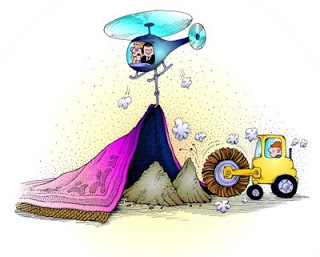
When there's too much dirt...

When there's too much dirt...
We need better tools... to cover up mega corruptions.

Prevent bullying now!

Prevent bullying now!
If you're not going to speak up, how is the world supposed to know you exist? “Orang boleh pandai setinggi langit, tapi selama ia tidak menulis, ia akan hilang di dalam masyarakat dan dari sejarah.” - Ananta Prameodya Toer (Your intellect may soar to the sky but if you do not write, you will be lost from society and to history.)

Saturday, January 30, 2016

Gopal Sri Ram: A-G's discretion under Article 145 (3)

Excerpt:
In the case of Long bin Samat decided in 1974, the Federal Court held that the attorney-general (A-G) had wide discretion to select the provision of the law under which to prosecute a person.
The pronouncement in this case has been read to affirm a wide discretion in the A-G whether to prosecute at all.
But if you look carefully at the judgment of Lord President Suffian in the case, it is clear that the Federal Court was only speaking of the A-G's wide discretion to choose the section of the law under which a person is to be prosecuted.
But in the case of Johnson Tan (1977), Suffian accepted that the discretion is not as wide as thought to be.
This is what he said: "In deciding that the A-G is not constrained by Article 8 when deciding whether or not to prosecute and if so on what charge, whether a lesser or a greater one, it must not be thought that he may act dishonestly.
"The public of whose interest he is the guardian has a right to expect him to act honestly, without fear of powerful national and local figures or of the consequences to him personally or politically, and without favouring his relatives and friends and supporters, his principal concern being to maintain the rule of law so that there will be no anarchy and to maintain standards in public life and the private sector; and if he did not do his duty honestly and properly the public would be able to show their disapproval not however in the courts but elsewhere and in the last resort by voting against the party of which he is a member."
This shows that an A-G must act honestly and that there is a legitimate interest in every member of the public that he will act honestly.
Another way of saying the same thing is that the A-G must act in good faith and must not be swayed by irrelevant considerations.
- See more at: http://www.themalaysianinsider.com/sideviews/article/a-g-s-discretion-under-article-145-3-gopal-sri-ram#sthash.3ZYCC4uY.dpuf
Link

Monday, January 25, 2016

Dr Kua Kia Soong: Dispelling misconceptions about the TPPA

Excerpt:

Allow me to dispel some misconceptions raised by some supporters of the TPPA who seem genuinely concerned about wanting Malaysia to submit to a higher “rule of law” trade regime yet appear naïve in making those assumptions.

Is the rejection of the TPPA a retreat into isolationism?

These supporters of the TPPA argue that a rejection of the TPPA is a retreat into isolationism. Some even use the examples of North Korea and Iran to scare Malaysians into accepting the Agreement. This is disingenuous indeed. For a start, North Korea and Iran have been forced into isolation because of sanctions applied by the world community. On the other hand, Malaysia, which is modelled along liberal democratic lines, has one of the most open globally interconnected economies in the world, without being in the TPPA. At the other end of the spectrum is China, which is run by the Chinese Communist Party and is doing pretty well thank you in its trade with countries in every continent even though it is being strenuously isolated from the TPPA by the US.

Will investors stop investing in Malaysia if we do not ratify the TPPA?

That depends on what we have to offer. If tenders cannot be won on merit, if corruption and commissions are the order of the day, if the rule of law is suspect, which investor would want to put their money here? But does the TPPA ensure such bad governance conditions will not prevail anymore? Think again!

Now, assume that we do not join the TPPA. Do you think Lynas will stop dumping their toxic rare earth in Kuantan? Will other Multinational Companies stop coming to invest in Malaysia if the Malaysian government continues with its union-bashing and low wage policies? Only the absolutely naïve would think so. It was the MNCs that demanded these policies in the first place when the first Free Trade Zones were established in Malaysia in the seventies.

Will the TPPA entrench the rule of law in Malaysia?

Some supporters of the TPPA are of the opinion that the binding stipulations in the Agreement will have a positive impact by strengthening the rule of law in Malaysia. The evidence shows otherwise. Now, even before we have signed the TPPA, the US has already lowered its standards on human rights for Malaysia. First, it upgraded the ranking for Malaysia’s record on human trafficking despite the shocking discovery of mass graves near the Thai border. Then it agreed to the Malaysian government’s request for racial discriminatory exemptions for Bumiputera interests in the TPPA.

The only “rule of law” that the TPPA is concerned about is securing the interests of multinational corporations whenever they face challenges to their profits. Thus the ISDS (Investor-State Dispute Settlement) mechanism is not so much the “rule of law” as the extrajudicial process written into the TPPA whereby governments can be dragged before supra-national tribunals by corporate lawyers if they think national laws violate their TPP rights or limit the MNCs’ expected profits.

Do you think the US is concerned about the “rule of law” in Malaysia beyond the ISDS? President Obama’s diplomatic replies to this question to placate the Najib government during his last visit is instructive. Is the US concerned about the rule of law in Saudi Arabia, their strongest ally in the Middle East?

More:
http://www.suaram.net/?p=7792
Link

Friday, January 22, 2016

I'm crazy, not stupid

This joke is worth repeating, and if it could help someone in a similar situation, it is worth it...

One truck driver was doing his usual delivery to Mental Hospital. He discovered a flat tyre when he was about to go home. He jacked up the truck and took the flat tyre down. When he was about to fix the spare tyre, he accidentally dropped all the bolts into the drain. As he can't fish the bolts out, he started to panic.

One patient happened to walk past and asked the driver what happened.

The driver thought to himself, since there's nothing much he can do, he told the patient the whole incident.

The patient laughed at him and said "Can't even fix such a simple problem... no wonder you are destined to be a truck driver..."

"Here's what you can do, take one bolt each from the other 3 tyres and fix them onto this tyre. Then drive to the nearest workshop and replace the missing ones, easy as that."

The driver was very impressed and asked:"You're s o smart but why are you here at the Mental Hospital?"

Patient replied: "Hello, I stay here because I'm CRAZY not STUPID!"
Link

Wednesday, January 20, 2016

What's up with WhatsApp? It's free!

My friend commented when forwarding to me the news:

'This is good news for all our WhatsApp users.   It's not so much as to the cheap subscription, it's about HOW to go about paying the subscription - using what ?  Credit card, PayPal, or some cumbersome form of payments?   Not all WhatsApp users have these.   Now that its definitely free, that worry is no longer there.'

From Androidcentral.com:

'WhatsApp has announced that it will axe its $1 annual subscription fee starting today. The Facebook-owned messaging service is nearing a billion users, and will start exploring alternate business models.

WhatsApp failed to monetize in emerging markets due to low debit and credit card penetration, which led to the service being offered for free. Today's announcement reflects a change of strategy that will see the platform acting as a facilitator between businesses and customers:

Naturally, people might wonder how we plan to keep WhatsApp running without subscription fees and if today's announcement means we're introducing third-party ads. The answer is no. Starting this year, we will test tools that allow you to use WhatsApp to communicate with businesses and organizations that you want to hear from. That could mean communicating with your bank about whether a recent transaction was fraudulent, or with an airline about a delayed flight.

We all get these messages elsewhere today – through text messages and phone calls – so we want to test new tools to make this easier to do on WhatsApp, while still giving you an experience without third-party ads and spam.

Facebook has already undertaken a similar strategy with Messenger, giving users the ability to chat with businesses. The feature will come in handy in countries like India, where WhatsApp is slowly becoming the de-facto method of communication.'

More: http://www.androidcentral.com/whatsapp-gets-rid-annual-subscription-fee
Link

Thursday, January 14, 2016

Kagan Goh: Recollections of David Bowie’s Serious Moonlight Tour to Singapore

In 1983, my father, Goh Poh Seng: doctor, poet, novelist, playwright, nightclub owner, businessman and entrepreneur was the sponsor and promoter of David Bowie’s Serious Moonlight Tour in Singapore. My father, widely acknowledged in hindsight as a pioneer of the Arts in Singapore and a man ahead of his time, almost went bankrupt financing the first big rock & roll concert in Singapore. I spent that summer holiday in 1983 with my best friends acting as tour guides showing Bowie’s bandmates the sights and sounds of Singapore. Initially, my father contemplated bringing Duran Duran but decided on the rock musical legend David Bowie instead. This was my first bona fide encounter with a real live rock star, a living legend who many considered to be the greatest rock musician of all time.

My father and I were waiting in excitement for Bowie to arrive at the Singapore international airport. When he cleared customs, my high school friend, Bernice Heng, got the honor and privilege of presenting him with a bouquet of flowers. Bowie was tall, towering over everyone. He was dressed in a baby blue three-piece suit and was smoking a cigarette. He bent down to kiss this short and rather shy and overwhelmed teenage girl on the cheek. The photographers from the press and newspapers were banned from printing the photograph in the newspaper taken of Bowie kissing my teenage friend because he was smoking a cigarette, something which was frowned upon and discouraged by the government campaign urging Singaporeans to quit smoking.

My father invited Bowie and his musicians to our home to listen to a live performance by classical Chinese musicians. Bowie’s band came but the man himself declined, saying that he did not “fraternize with concert promoters.” My father sent David Bowie a message through his personal assistant, telling him to tell Mister Bowie that “he is only a rock star. I, however, am a poet.” Bowie came to meet my father in person hat in hand to apologize for his rudeness. My father told Bowie that two of his songs had been banned from radio play. “This rock & roll business is more than just drugs, sex and rock and roll and making money, it is about freedom of speech. Perhaps people in the West take this freedom for granted. But I know poets and writers in Asia who have been imprisoned for their writing. Here, freedom of speech is something people are willing to fight for, even die for.” Fired up by my father’s words, Bowie kicked off his concert with the two banned songs, galvanized by his band attacking the stage like a squad of guerilla soldiers on the rampage.

More:
http://www.gohkagan.com/

Link