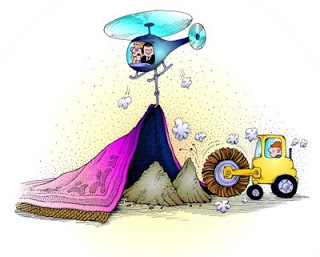
How should we judge a government?

In Malaysia, if you don't watch television or read newspapers, you are uninformed; but if you do, you are misinformed!

"If you're not careful, the newspapers will have you hating the people who are being oppressed, and loving the people who are doing the oppressing." - Malcolm X

Never argue with stupid people, they will drag you down to their level and then beat you with experience - Mark Twain

Why we should be against censorship in a court of law: Publicity is the very soul of justice … it keeps the judge himself, while trying, under trial. - Jeremy Bentham

"Our government is like a baby's alimentary canal, with a happy appetite at one end and no
responsibility at the other. " - Ronald Reagan

Government fed by the people

Government fed by the people

Career options

Career options
I suggest government... because nobody has ever been caught.

Corruption so prevalent it affects English language?

Corruption so prevalent it affects English language?
Corruption is so prevalent it affects English language?

When there's too much dirt...

When there's too much dirt...
We need better tools... to cover up mega corruptions.

Prevent bullying now!

Prevent bullying now!
If you're not going to speak up, how is the world supposed to know you exist? “Orang boleh pandai setinggi langit, tapi selama ia tidak menulis, ia akan hilang di dalam masyarakat dan dari sejarah.” - Ananta Prameodya Toer (Your intellect may soar to the sky but if you do not write, you will be lost from society and to history.)

Saturday, October 20, 2012

The spirit is willing but the flesh is weak


A lady goes to her  priest one day and tells him, 'Father, I have a  problem. I have two female  parrots, But they only know to  say one thing'

'What do they say?'  the priest asked.

They say, 'Hi, we're  hookers! Do you want to have some fun?'

'That's obscene!' the  priest exclaimed, Then he thought for a  moment... 'You know,' he said, 'I may have a solution to your problem. I  have two male talking parrots, which I have taught to pray and read the  Bible...
Bring your two  parrots over to my house, and we'll put them in the cage with Francis and  Peter. My parrots can teach  your parrots to pray and worship, and your parrots are  sure to stop saying... That phrase... In no time.'

'Thank you,' the  woman responded, 'this may very well be the solution.'

The next day, she  brought her female parrots to the priest's house.... As he ushered her  in,  she saw that his two  male parrots  were inside their  cage holding rosary beads and praying. Impressed, She walked  over and placed her parrots in with them...

After a few minutes,  the female parrots cried out in unison: Hi, we're hookers! Do  you want to have some fun?'

There was stunned  silence...

The one male parrot  looked over at the other male parrot and said, 'Put the beads away,  Frank, our prayers  have been  answered!

Link

Friday, October 19, 2012

A bit on Tanah Rata history

I have seen a plaque on the front wall of a post office in Tanah Rata, Cameron Highlands, which commemorated its opening on June 25, 1956 by then Chief Minister of Pahang, Tunku Abdul Rahman Putra. He was to become our first Prime Minister just over a year later!

It was before Malaya's independence on August 31, 1957, which explains why Tunku's position was described as Chief Minister instead of Menteri Besar. This bit on our local history was overshadowed by someone's bad news.

Today, while window shopping in Tanah Rata, we met our Dutch friend who related to us how her 11-year old daughter was diagnosed with POTS (Postural orthostatic tachycardia syndrome). It took them a year before the doctors discovered her rare condition. The mother said earlier, she even doubted her complaints and dismissed them as her excuses for not wanting to attend school. Based on present medical knowledge, it is incurable and strict diet and medicine could only alleviate her symptoms.

I did a quick search and found the following in Wikipedia:

"Postural orthostatic tachycardia syndrome (POTS, also postural tachycardia syndrome) is a condition of dysautonomia,[1] to be more specific orthostatic intolerance, in which a change from the supine position to an upright position causes an abnormally large increase in heart rate, called tachycardia. Several studies show a decrease in cerebral blood flow with systolic and diastolic cerebral blood flow (CBF) velocity decreased 44% and 60%, respectively.[2] Patients with POTS have problems maintaining homeostasis when changing position, i.e. moving from one chair to another or reaching above their heads. Many patients also experience symptoms when stationary or even while lying down.
Symptoms present in various degrees of severity depending on the patient. POTS can be severely debilitating. Some patients are unable to attend school or work, and especially severe cases can completely incapacitate the patient."
Over the years, we watched Joy grew from baby to her present age. Now she is debilitated by this dreadful health problem. So sad. We hope her health will improve despite all the pessimistic prognosis.

Link

Thursday, October 18, 2012

Genneva Gold: Early bird catches the worm

or 'siapa cepat, dia dapat' in Malay.

For those who invested early and got out early, they would have gained according to what was claimed by the promoters. Like the Ponzi scam or pyramid scheme, investments of later investors were used to pay off early investors...

"Another burning question – if the company’s account and asset were seized and frozen since 2009, how can the directors and company allowed to operate until the latest raid early this month, more than 3-years later? Was Bank Negara sleeping on the job? Were there too many (greedy) hands in the cookie jar, hence the power struggle (or rather money struggle), considering the gigantic amount of money in the coffer (if there’s any left). Or was it purely SOP (standard operating procedure) by any ponzi scheme operator to call it the day by asking the authorities to raid the company itself so that they can stop paying investors, knowing very well nobody would go to jail?"


Read all about it in Finance Twitter:
http://www.financetwitter.com/2012/10/genneva-gold-another-collapsing-ponzi-scam.html

A relevant cartoon on Ponzi Scheme...


Link

AES: Another entrapment scheme?

The Automated Enforcement System (AES), since its initial installations at selected locations, has been severely criticised by the public, opposition leaders and even some BN leaders. The superior system as compared with earlier ones, is claimed to be foolproof in providing incontrovertible evidence to nail traffic offenders. The speed at which it is able to issue summons within 5 days is commendable since earlier complaints were about the long lapse in time since an alleged offence.

My personal experiences with the old system (if it can be called a system) at different times and locations had convinced me of its weaknesses. As a frequent traveller of the old trunk road and later North-South Expressway, especially between KL and Batu Gajah almost every weekend for 12 years (1982-1994), my record of being stopped by police for alleged offences was few and far between. Yet, there were mistakes by the police.

I was stopped just after the flyover over Jalan Ipoh-Jalan Kepong roundabout by some police for alleged speeding. Another time was along the trunk road after Gopeng where the speed limit was 90 km/h. Then, there was once along the quiet stretch (through a kampung) near Chenderiang and before Temoh, where the speed limit was at an impractical 60 km/h. In retrospect and with experience, I would not have entertained their offers of settlement since they had no evidence. All three were obvious roadblocks set up to make some extra money for themselves.

Once, while on my way, I was booked for overtaking a lorry at a double-lined road near Templers' Park. I argued with then OCPD ACP Murray over what if it was a slow steam-roller? He said the police was only enforcing traffic rules set by Highway Authority and he was kind enough to reduce it to Rm30. On another trip, I was stopped on the NSE near Gua Tempurung and was issued a summons for speeding near Tapah interchange (in other words, warnings by oncoming vehicles were too late). I was told I could appeal for a reduced fine. So on my way back to KL, with an appeal letter promising not to exceed speed limits, I went to see the traffic officers in Tapah police station. I was told that they cannot reduce by more than 50%, so the fine of Rm150 (based on the speed exceeding the limit) was reduced to Rm80. It was a year or two later that I received a summons for travelling at over 100 km/h along Jalan Duta, KL! Fortunately, I was sure my usual speed along that particular road never reached that speed, and on top of that, it was on National Day when I was likely to have been back in BG to be with my family. A police officer who helped me to check, confirmed that the registration number and even the make of car was wrong! It looked like a Volvo 240 instead of my old BMW 728i! Since then, I am convinced that the 'mistake' could be the work of an overzealous policeman who used details in their record to try their luck on some unfortunate vehicle owners.

Another instance was even more incredible. I was with a sister-in-law, taking my mother-in-law on a northbound trip from BG. After the tunnel (NSE), my SIL commented about my slow speed. I told her that I could not afford heavy fines and being the driver, I was responsible for my action. Despite that, when we were flagged down by police near Bukit Merah laketown, I was both apprehensive and annoyed at myself. I am sure most drivers would agree that we can never be perfectly sure that we had not exceeded the speed limits during a road trip. But I was determined to accept any summon and would ask for photo to prove it later. So my serious and unhappy expression was shown to the policeman who came near our car. Just before that, my lawyer SIL joked that we will take it all the way to Privy Council, an actual experience which she had dealt with before over a land matter. Somehow, we were let off! Till today, I cannot be sure whether it was because there was no basis in the first place or that he could tell from my serious expression that I was sure I didn't commit the offence!

Coming back to the AES. According to Chua Jui Meng,

"If the BN government’s intention to save the rakyat from fatal road crashes is sincere, then it should have the right infrastructure fully in place before enforcing the AES.

Australia has one of the lowest rates of road accidents in the world. Why is that? Because they use the Global Positioning System (GPS) and LED boards to warn motorists of speed trap cameras installed at dangerous road and highway stretches.

The Australian government’s intention is to help save lives by telling motorists to slow down at such “death stretches”, not collect hefty fines for revenue.

Compare that with the BN government. They implement the AES to catch and slap hefty fines on motorists! The BN’s intention is clearly not about saving lives but to collect hefty fines..."

Rest of his article...
AES: Money over safety
http://en.harakahdaily.net/index.php/letter/5923-aes-money-over-safety.html

Personally, I wish AES at traffic light junctions would prevent motorcyclists who now have the habit of following rule of their own: ignore traffic lights and proceed when they think other vehicles have yet to make a move!
Link

Wednesday, October 17, 2012

Prudence is the key to good financial management


According to a leading lawyer, Tommy Thomas, in his letter to Malaysiakini:

"...The reason why contingent liabilities should, as a matter of prudence, be included is because it is in effect "a liability" which may sometime in the future be crystallised.

The largest component under "contingent liabilities" is apparently the guarantee, a long established and widely used financial instrument, which involves three parties; the lender, the borrower and the guarantor.

It arises because the lender is not sufficiently satisfied that the borrower has the financial means to repay his debt.

Accordingly, the lender insists that the borrower's debt be guaranteed by a third party, the guarantor, which then entitles the lender to have recourse against two separate persons (the borrower and the guarantor) in the event that the borrower defaults.

In such a tripartite relationship, the borrower and the guarantor assume legal liability at the time their respective contracts are signed. Thus, the guarantor faces an exposure..."

Rest of his article:

National budget must reflect guarantees by nation

News after publication of the Auditor General's Report ...
Govt-guaranteed debt breaks Rm100 billion mark

In my humble opinion:

Financial management, accounting and auditing used to be straightforward, and basically, what you see was what you get. Then a person or a company's net worth could easily be calculated with the addition of all assets minus all liabilities. Even then it depended on what was known, but what about those items which had not been revealed? A company's balance sheet might have off-balance sheet items which were undisclosed but which could have disastrous consequences. A lot depended on the integrity of the company's management and its external auditors.

Since then, financial statements of a large group of companies have become too complex to the laymen, and even older accountants have problems understanding them. But let's not fret over that and use simple examples to illustrate my point on the importance of financial prudence.

A person applying for a housing loan might be appraised according to his monthly income to ensure he is able to repay the loan over its tenure. If he has other commitments like HP loan repayments on his car and other major items, then his financial capability could be adversely affected and his prospective housing loan banker might reconsider his application based on such relevant information. His already stretched financial commitments could further be burdened if he had acted as guarantor for others' loans, if and when those borrowers failed to honour their commitments.

In the old days, banks' ability to pay their depositors was never questioned. The banks were required to deposit with Bank Negara, a minimum percentage known as Statutory Liquidity Ratio (now Statutory Reserve Requirement?) which could be used when there was a run on a particular bank. The central bank would guarantee all deposits with the banks under its control. (I believe the old SLR at 20% (when I first read it way back in 1969!) is now the SRR which is currently at 2%)

Recently, it was publicly announced that banks would guarantee any bank deposit up to Rm 60,000, which has since been increased to its present Rm250,000. To me, there is now uncertainty (unlike before) as to whether any commercial bank can pay back all deposits with them. The complexity of banking must have reached a stage where nobody knows exactly whether any bank could withstand a run on it.

There is also concern over Non-performing Loans (NPLs) within banks which are reported to have been sold to third parties, including foreign entities. Cases of housing loan borrowers who found to their shock, that their houses have been auctioned without their knowledge by third parties, showed the extent of the problem caused by this illegal selling of NPLs. Of course, the illegality of such transactions was made legal when sanctioned by a prior blanket approval by the Minister of Finance. But the wisdom of it in terms of financial prudence has yet to be tested.

The situation of NPLs can be serious because of its size. To put it simply, NPL of a lax bank can easily be more than its paid capital and reserves. Just imagine if most, if not all of it, is actually bad or non-recoverable! Doesn't that remind us of the toxic assets of American banks which caused the collapse of world's biggest names in banking?

When dealing with finance, prudence is the key to its sound management. Accountants are trained to follow this important principle. Stocks are valued at the lower of cost or recoverable value; debtors are stated, less any known or possible irrecoverable portion; incomes are recognized when legally proper to do so and expenses or commitments to spend properly provided for.

By extension, shouldn't this vital principle of prudence be applied to our country's financial management? There are currently some complaints about our national debt being too close to, if not already exceeding the approved ratio; some believe the national debt was intentionally understated, especially with the omission of contingent liabilities in the form of guarantees given by the government.

Update: As they say, a picture shows more than a thousand words, the following graphic (courtesy of Martin Jalleh and Malaysiakini) shows our unhealthy public financial situation:


Question: Are there any other hidden liabilities which we are unaware of?

The pensioners and other beneficiaries of BR1M and other handouts are happy, but they wonder where the money is coming from!


Link