Taking the easy way to teach my children some Hokkien, I take the liberty to copy from TV Smith's excellent article posted in his Dua Sen on 11/04/05.
"If there's a Chinese worker kidnapped in a rogue state, you can bet your arm that he's from Fujian Province" says an article in Running Dog. The Fujians (or Hokkiens as they are known here) are the unsung heroes of the far-flung Chinese diaspora.
The Hokkiens may be the biggest Chinese dialect group in Malaysia but the fact usually goes unnoticed except for one particular night. On the 9th day of the Chinese New Year, closet Hokkiens set off the loudest bang on earth. Armed with enough firepower to upset the earth's rotation - but thankfully restrained by the law - they settle for pissing off neighbours, pets and cops.
Most outsiders, understandably, consider Cantonese as the predominant Chinese dialect of Malaysia. In reality, Hokkien is the 'lingua franca' for many Chinese in Penang, Kedah, Kelantan, Trengganu, Malacca and Johor. Within the Klang Valley, Hokkien is also widely spoken in Klang, Kepong and Setapak. So how did we end up with this popular misconception? Some say it was due to a misguided political move to limit the use of Mandarin on our airwaves during the 80's. Mandarin was then promoted as an unifying language in the Hokkien strongholds of Singapore and Taiwan.
But why pick Cantonese instead of Hokkien? Firstly, ignorant advertisers thought only Cantonese consumers (of Klang Valley) had purchasing power. It didn't help that most Hokkiens spoke Cantonese and not vice-versa. Secondly, Hokkien television programmes from Fujian State TV and even Taiwan sucked big time. The soaps were overly melodramatic and its production quality flaky. In contrast, their southern neighbours in Hong Kong were light years ahead in technique and content. Thirdly, the dialect itself consists of so many sub-dialects and regional variations, making 'standardisation' impractical.
The Hokkiens were running away from home since the cavemen days but the first major exodus was at the turn of the last century. Many of them landed in Ma Lai Ar with only a shirt on their back. Through grit, grind and a frugal diet of chai por, a number of them became octogenarian billionaires and tan slee. Ironically, in some cases, their educated heirs reversed the hard-earned fortune almost overnight.
Other illustrious descendants conquered the political world (Latuk Slee Dr Lim Keng Yaik - Gerakan, Latuk Slee Ong Ka Ting - MCA, Saudala Lim Kit Siang - DAP) and the blogsphere (Bolok Ong Jeff Ooi - Screenshots). By the way, there is now also a Hokkien bolok (blog), albeit in romanised form.
If the Malays contributed the words amok and 'rangutan to the English language, the Hokkiens' only contribution must be the universal word; tea (from teh). The influence of the Malay language on colloquial Hokkien is undoubtedly unique, especially when many of the original words were borrowed from Sanskrit, Portuguese, Arabic and English. This linguistic mixture is a living testimony of our nation's colourful and diverse cultural heritage.
Hokkien > Malay
Beh Chia - Becha (horse carriage)Bee Hoon - Bihun (vermicelli)Chat - Cat (paint)
Chin Chai - Cincai (easy)Gian - Gian (addicted)Gua - Gua (me)Goli - Guli (marble) Kantang - Kentang (potato)Kam Cheng - Kamcheng (close)Kau - Kau (thick)
Ker - Kuih (pastry)Kongsi - Kongsi (share)Kueh Chee - kuaci (melon seeds)
Lu - Lu (you)Mi - Mee (noodles)Pan - Papan (wood)
Sar Tay - Satay (3 pieces, from Hainanese)Teh Kor - Teko (teapot)Tengki - Tengki (IC)Tau Geh - Taugeh (bean sprout)Tow Hoo - Tauhu (beancurd)Towkay - Tauke (boss)
Malay > Hokkien
Agak - Agak (estimate)Baru - Balu (recently)Belacan - Balachian (shrimp paste)
Botak - Botak (bald)Diam - Tiam (quiet)Durian - Liulian (durian)Duit - Lui (money)Gaji - Gaji (pay)Hutang - Otang (debt) Jamban - Jamban (toilet)
Kacau - Kachiau (disturb) Kahwin - Kauin (marry)Kaki - Kaki (own, self)
Kari - Kali (curry)Kaya - Kaya (coconut egg jam)Lelong - Lay Long (auction)
Longkang - Long Kau (drain)Main - Main (play) Mana - Mana (where)
Mata Mata - Mata (cop)Misai - Misai (moustache)Pancit - Pumchet (puncture)
Pandai - Pan Nai (clever)Pantang - Pantang (superstitious)Pakat - Pakat (conspire)Pasar - Parsat (market)Pecah - Pit Chia (break)Roti - Loti (bread)
Samseng - Sam Seng (gangster)Sabun - Sap Bun (soap)Salah - Salah (wrong)
Sama - Sama (all)Saman - Sambang (summons)Sayang - Sayang (pity, waste)
Sekali - Skali (again)Senang - Sinang (easy)Senget - Senget (crooked)
Sombong - Som Bong (unfriendly)Sotong - Sortong (squid)Suka- Sukak (like)
Tahan - Tahan (withstand)Tapi - Tapi (but)Tiga Suku - Sar Suku (crazy)
Tikam Tikam - Tikam (draw)Timun - Timun (cucumber)Tolong - Tor Long (help)
Some local Hokkien words are innocuous but may sound offensive with changing times:
Ahmad (driver)Bang Ka Li (Sikh)Huan Kia or Huan Na (Malay)Kek Leng Kia (Indian)Sakai (Orang Asli)Sek Kia Ni (Serani)
Others sound bizzare but are actually quite logical (etymologically):
Ang Mo Liulian - (mangosteen) (corrected to soursop)
Butokan - (bottle)
Chiak Hong - (eat wind > vacation)
Holland Tau (peas)
Kana Kiu - (olive ball > rugby game)
Tua Kow - Big dog (police inspector)
Tua Kow reminds me of a story related to me by my father:
A Hokkien man went to see the police inspector to seek the release of his son. "Ai yah, Anjing busat tua kow ko, gua kasi lu ayam lua eko..." (Ah yes, elder brother Big dog, I give you two chickens...)
The Malay inspector angrily dismissed him with a reply, "Pergi lah, babi." (Go away, pig)
The poor man went home disappointed and told his wife, "E mai kueh, e ai tu." (He did not want chicken, he wanted pig.)
Government fed by the people

Career options

I suggest government... because nobody has ever been caught.
Corruption so prevalent it affects English language?

Corruption is so prevalent it affects English language?
When there's too much dirt...
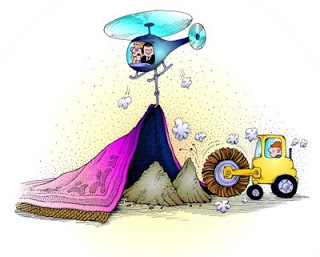
We need better tools... to cover up mega corruptions.
Prevent bullying now!

If you're not going to speak up, how is the world supposed to know you exist? “Orang boleh pandai setinggi langit, tapi selama ia tidak menulis, ia akan hilang di dalam masyarakat dan dari sejarah.” - Ananta Prameodya Toer (Your intellect may soar to the sky but if you do not write, you will be lost from society and to history.)
Wednesday, October 03, 2007


Wise words since Confucius...
On Marriage:
Don't marry the person you want to live with, marry the one you cannot live
without... but whatever you do you'll regret it later.
You can't buy love ... but you pay heavily for it.
Marriage is a relationship in which one person is always right and the other is the husband!
My wife and I always compromise. I admit I'm wrong and she agrees with me.
It doesn't matter how often a married man changes his job, he still ends up with the same boss.
They call our language the mother tongue because the father seldom gets to speak.
Having one child makes you a parent; having two makes you a referee.
A child's greatest period of growth is the month after you've purchased new school uniforms.
Saving is the best thing. Especially when your parents have done it for you.
on Friendship:
True friends stab you in the front.
Forgiveness is giving up my right to hate you for hurting me.
Real friends are the ones who survive transitions between address books.
and generally:
Regular naps prevent old age... especially if you take them while driving.
They said we should all pay our tax with a smile. I tried - but they wanted cash.
Bad officials are elected by good citizens who do not vote.
Laziness is nothing more than the habit of resting before you get tired.
Those who can't laugh at themselves leave the job to others.
Ladies first. And then pretty ladies first.
Wise men talk because they have something to say; fools talk because they have to say something.
Don't marry the person you want to live with, marry the one you cannot live
without... but whatever you do you'll regret it later.
You can't buy love ... but you pay heavily for it.
Marriage is a relationship in which one person is always right and the other is the husband!
My wife and I always compromise. I admit I'm wrong and she agrees with me.
It doesn't matter how often a married man changes his job, he still ends up with the same boss.
They call our language the mother tongue because the father seldom gets to speak.
Having one child makes you a parent; having two makes you a referee.
A child's greatest period of growth is the month after you've purchased new school uniforms.
Saving is the best thing. Especially when your parents have done it for you.
on Friendship:
True friends stab you in the front.
Forgiveness is giving up my right to hate you for hurting me.
Real friends are the ones who survive transitions between address books.
and generally:
Regular naps prevent old age... especially if you take them while driving.
They said we should all pay our tax with a smile. I tried - but they wanted cash.
Bad officials are elected by good citizens who do not vote.
Laziness is nothing more than the habit of resting before you get tired.
Those who can't laugh at themselves leave the job to others.
Ladies first. And then pretty ladies first.
Wise men talk because they have something to say; fools talk because they have to say something.
Tuesday, October 02, 2007
Confucius (K’ung Fu-tze) 551 to 479BC.
A few days ago, my wife took an injured foreign employee to see an Ipoh GP, Dr. Ho Tak Ming, and she bought an autographed copy of his book, “Doctors Extraordinaire”, which I have been reading selectively.
There were many outstanding doctors mentioned but I was most attracted by the story behind a doctor’s wife, Sybil Kathigasu, who suffered and later died of serious injuries after being tortured by Japanese soldiers for not telling on the hundreds of local freedom fighters. Her husband’s former clinic in Papan, Perak is now a historic reminder of her courage and heroic act.
I was also attracted by the story on the descendants of Confucius, “Khong Thye Cheng who did well and became the patriarch of an illustrious family, later spread in Malaysia and Singapore. He was able to send his third son, Khong Kam Tak, to study medicine in England. Dato’ Dr Khong Kam Tak, born in Penang on 30th December, 1884, was a direct descendant of K’ung Fu-tze of the 74th generation. Together with forty to fifty thousand male-line descendants of the K’ung family in China and elsewhere, according to Debrett’s Guide to Tracing your Ancestry, they had possibly the oldest traceable human Y-chromosomes in the world! Moreover, Confucius himself was a scion in the direct male line, through the dukes of Sung, of the proto-historic Shang dynasty (1766-1121BC).”
“In the present-day city of Qufu in Shandong province, the house of K’ung Fu-tze still remains, the place where he taught his disciples, his tomb and the surrounding forest where a hundred thousand of his male descendants are buried. Their genealogy had been treasured by Chinese scholars throughout two and a half millennia in the great Chia Pu or family name book. Qufu is the unacknowledged Vatican of China, patrimony of Confucius’ descendants, ‘the first family under heaven’. Here they lived for nearly 2,000 years until the Mongol and Manchu invasions from the north forced many of them to flee to the south, some settling down in the province of Kwangtung. In the nineteenth century, when China’s economy was disrupted following the Opium Wars and the opening of the Treaty Ports, resulting in the disintegration of provincial government and increasing lawlessness, some clan members had to go even further south, across the southern ocean to a new country. The boat that these pioneers sailed in landed at Lumut in Perak, on the west coast of Malaya. They stayed there for some time, then went further north and finally settled in Penang.”
“K’ung Fu-tze was the first and greatest teacher and philosopher in China. With persistence and selflessness, he set about to bring order and peace to the anarchy of his age, wandering through the states of China looking for a ruler willing to employ him and his ideas in the government, and gathering disciples to transmit these ideas to them. He believed that the solution to the ills and evils of society was a return to virtue – by embracing the ideals of jen (humanity or benevolence), chih (uprightness), I (righteousness), chung (conscientiousness towards others) and shu (reciprocity). Shunning any divine or supernatural sanction for his teachings, he concentrated instead on humanism, emphasising man’s potential for perfectibility, of becoming a chun-tzu, a gentleman or ‘superior man’, through learning and culture, and through observance of li, the proper rites or proprieties, and the attainment of a perfect moral order through correct human relationships in a hierarchical society. The Confucian Way, said the T’ang scholar Han Yu, was a way of action: action animated by the ideal of justice and motivated by love for all men.”
“For centuries the Confucian school remained only one among many rival schools of philosophy. It was during the Han, in the second century BC, that Confucianism was declared the official creed of the country, and the Confucian classics became the main, if not the sole, study of all scholars and statesmen. Government was basically an ethical problem, and the first duty of the ruler was to set an example of sound ethical conduct. It was his virtue, and the contentment of the people, that was the true measure of political success. Confucius was China’s first great moralist, the founder of a great ethical tradition in a civilisation that above all others came to concentrate on ethical values. It was Confucian ethics that provided the spiritual basis in Chinese civilisation, comparable t that of religion in other civilisations, giving it stability and resilience, enabling it to remain essentially unchanged for over 2,000 years.”
“Until its disintegration early in the twentieth century, the form of government that China had was one of the best in the world, judged by the vastness of the country and the size of its population, its record in promoting the unity of its empire and maintaining order and ensuring justice. The Emperor was supposed to reign but not to rule, and employed upright and able ministers to administer the country. The bureaucracy was recruited through competitive civil service examinations. The men who entered the civil service had a uniform grounding in the Confucian classics. So prestigious was this governing class that the masses, too, were inculcated with Confucian values, which laid great emphasis on correct relations among human beings, beginning with the family. The state was an enlarged family. The people were to be reasoned with and educated on their duties to one another and to the government. Human society could prosper only if men preserved harmonious relations to one another and to the universe about them.”
“In the nineteenth century began the Chinese diaspora, where emigrants from China settled down in all corners of the globe. However, even beyond the four seas, they all shared the same Confucian values: reverence for ancestors, respect for elders, loyalty to family, clan and lineage, diligence and frugality, high regard for education, and a responsible, rational approach to society.”
(Extracts from ‘Doctors Extraordinaire’ by Dr. Ho Tak Ming)
I think the story on Confucius is particularly helpful to those not literate in Chinese, like myself and my children, and non-Chinese, in understanding the traditional values and mindset of the Chinese all over the world.
There were many outstanding doctors mentioned but I was most attracted by the story behind a doctor’s wife, Sybil Kathigasu, who suffered and later died of serious injuries after being tortured by Japanese soldiers for not telling on the hundreds of local freedom fighters. Her husband’s former clinic in Papan, Perak is now a historic reminder of her courage and heroic act.
I was also attracted by the story on the descendants of Confucius, “Khong Thye Cheng who did well and became the patriarch of an illustrious family, later spread in Malaysia and Singapore. He was able to send his third son, Khong Kam Tak, to study medicine in England. Dato’ Dr Khong Kam Tak, born in Penang on 30th December, 1884, was a direct descendant of K’ung Fu-tze of the 74th generation. Together with forty to fifty thousand male-line descendants of the K’ung family in China and elsewhere, according to Debrett’s Guide to Tracing your Ancestry, they had possibly the oldest traceable human Y-chromosomes in the world! Moreover, Confucius himself was a scion in the direct male line, through the dukes of Sung, of the proto-historic Shang dynasty (1766-1121BC).”
“In the present-day city of Qufu in Shandong province, the house of K’ung Fu-tze still remains, the place where he taught his disciples, his tomb and the surrounding forest where a hundred thousand of his male descendants are buried. Their genealogy had been treasured by Chinese scholars throughout two and a half millennia in the great Chia Pu or family name book. Qufu is the unacknowledged Vatican of China, patrimony of Confucius’ descendants, ‘the first family under heaven’. Here they lived for nearly 2,000 years until the Mongol and Manchu invasions from the north forced many of them to flee to the south, some settling down in the province of Kwangtung. In the nineteenth century, when China’s economy was disrupted following the Opium Wars and the opening of the Treaty Ports, resulting in the disintegration of provincial government and increasing lawlessness, some clan members had to go even further south, across the southern ocean to a new country. The boat that these pioneers sailed in landed at Lumut in Perak, on the west coast of Malaya. They stayed there for some time, then went further north and finally settled in Penang.”
“K’ung Fu-tze was the first and greatest teacher and philosopher in China. With persistence and selflessness, he set about to bring order and peace to the anarchy of his age, wandering through the states of China looking for a ruler willing to employ him and his ideas in the government, and gathering disciples to transmit these ideas to them. He believed that the solution to the ills and evils of society was a return to virtue – by embracing the ideals of jen (humanity or benevolence), chih (uprightness), I (righteousness), chung (conscientiousness towards others) and shu (reciprocity). Shunning any divine or supernatural sanction for his teachings, he concentrated instead on humanism, emphasising man’s potential for perfectibility, of becoming a chun-tzu, a gentleman or ‘superior man’, through learning and culture, and through observance of li, the proper rites or proprieties, and the attainment of a perfect moral order through correct human relationships in a hierarchical society. The Confucian Way, said the T’ang scholar Han Yu, was a way of action: action animated by the ideal of justice and motivated by love for all men.”
“For centuries the Confucian school remained only one among many rival schools of philosophy. It was during the Han, in the second century BC, that Confucianism was declared the official creed of the country, and the Confucian classics became the main, if not the sole, study of all scholars and statesmen. Government was basically an ethical problem, and the first duty of the ruler was to set an example of sound ethical conduct. It was his virtue, and the contentment of the people, that was the true measure of political success. Confucius was China’s first great moralist, the founder of a great ethical tradition in a civilisation that above all others came to concentrate on ethical values. It was Confucian ethics that provided the spiritual basis in Chinese civilisation, comparable t that of religion in other civilisations, giving it stability and resilience, enabling it to remain essentially unchanged for over 2,000 years.”
“Until its disintegration early in the twentieth century, the form of government that China had was one of the best in the world, judged by the vastness of the country and the size of its population, its record in promoting the unity of its empire and maintaining order and ensuring justice. The Emperor was supposed to reign but not to rule, and employed upright and able ministers to administer the country. The bureaucracy was recruited through competitive civil service examinations. The men who entered the civil service had a uniform grounding in the Confucian classics. So prestigious was this governing class that the masses, too, were inculcated with Confucian values, which laid great emphasis on correct relations among human beings, beginning with the family. The state was an enlarged family. The people were to be reasoned with and educated on their duties to one another and to the government. Human society could prosper only if men preserved harmonious relations to one another and to the universe about them.”
“In the nineteenth century began the Chinese diaspora, where emigrants from China settled down in all corners of the globe. However, even beyond the four seas, they all shared the same Confucian values: reverence for ancestors, respect for elders, loyalty to family, clan and lineage, diligence and frugality, high regard for education, and a responsible, rational approach to society.”
(Extracts from ‘Doctors Extraordinaire’ by Dr. Ho Tak Ming)
I think the story on Confucius is particularly helpful to those not literate in Chinese, like myself and my children, and non-Chinese, in understanding the traditional values and mindset of the Chinese all over the world.
Dumb and dumber
In Ireland there is a mental institution that every year picks two of its most reformed patients and questions them. If they get the questions right they are free to leave.
This year the two lucky patients were Patty and Mike. They were called down to the office and left there by the orderly. They were told to wait as the doctor got their files. The doctor came out and motioned for Patty to come in for her questioning. When Patty came into the office she was instructed to sit in the seat across from the doctor.
"Patty, you know the tradition of this institution so I imagine you know why you are here. You will be asked two questions, and if you get them right, you will be free to go. Do you understand all that you have been told?" said the doctor with a rather sly grin. Patty nodded, and the doctor began to question her.
"Patty, if I were to poke out one of your eyes, what would happen?" "I would be half blind of course," Patty answered without much thought. "What would happen if I poked out the other eye?" "I would be completely blind," said Patty knowing that she had just gotten her freedom. The doctor then sent her outside while he drew up the paperwork and accessed Mike's files.
When Patty got into the waiting room however, she told Mike what the questions would be and what the correct answers were. The doctor calls in Mike and he followed the same procedure that he had with Patty.
"Mike, the first question is what would happen if I cut off your ear?" "I would be blind in one eye," he said remembering what he had been told. This received a perplexed look from the doctor but he just simply asks the other question so that he could figure out what the man was thinking.
"Mike, what would happen if I cut off your other ear?" "I would be completely blind," he answered with a smile as if he knew he had passed.
But then the doctor asked him what his reasoning was, and he said flatly, "Me hat would fall down over me eyes."
This year the two lucky patients were Patty and Mike. They were called down to the office and left there by the orderly. They were told to wait as the doctor got their files. The doctor came out and motioned for Patty to come in for her questioning. When Patty came into the office she was instructed to sit in the seat across from the doctor.
"Patty, you know the tradition of this institution so I imagine you know why you are here. You will be asked two questions, and if you get them right, you will be free to go. Do you understand all that you have been told?" said the doctor with a rather sly grin. Patty nodded, and the doctor began to question her.
"Patty, if I were to poke out one of your eyes, what would happen?" "I would be half blind of course," Patty answered without much thought. "What would happen if I poked out the other eye?" "I would be completely blind," said Patty knowing that she had just gotten her freedom. The doctor then sent her outside while he drew up the paperwork and accessed Mike's files.
When Patty got into the waiting room however, she told Mike what the questions would be and what the correct answers were. The doctor calls in Mike and he followed the same procedure that he had with Patty.
"Mike, the first question is what would happen if I cut off your ear?" "I would be blind in one eye," he said remembering what he had been told. This received a perplexed look from the doctor but he just simply asks the other question so that he could figure out what the man was thinking.
"Mike, what would happen if I cut off your other ear?" "I would be completely blind," he answered with a smile as if he knew he had passed.
But then the doctor asked him what his reasoning was, and he said flatly, "Me hat would fall down over me eyes."
Monday, October 01, 2007
The most influential man in Malaysia today...
the fearless Editor of Malaysia Today.

His enemies would love to see him...

take that!...

and that!
Seriously, my son said I am addicted to his exposes.

His enemies would love to see him...

take that!...

and that!
Seriously, my son said I am addicted to his exposes.
Subscribe to:
Posts (Atom)